Skip to content
X
XKMato
Sep 30, 2026, 4:21 PM

"Make them all your friends," Jajja Kintu advises.

Who told you that you're poor? Are there not those who have less than you do who believe themselves rich? Before you can get what you love, you must first learn to love what you have. Changing what you love is growth. Changing what you must is repair. Growth turns something into more than it was before. Repair turns something back into what it was before it broke.

Who told you that you're broken? Who told you that you're a sinner? Who made you a victim?

Can you see that getting what you want won't cure you of the wanting? Can you see that the pain is in the wanting itself, and not the object of the wanting?

All I can teach you is that freedom is in befriending the wanting, because that will live with you forever. Don't try to control your wanting, and don't let it control you. That is how a friendship works. And only friendship is the path to harmony.

You're not poor. You just need to learn what you want and befriend it.

14
Explore in Mind Map →
"Who told you you're poor?"← Connected from
Open post →

Directly echoes the Genesis question's exact phrasing—asking 'Who told you that you're poor?' to expose implanted inadequacy.

X
XKMato
1mo ago

"Who told you that you're naked?" God asked Adam.

Jajja Kintu on loving what is← Connected from
Open post →

Shares the exact non-transactional view of gratitude through Jajja Kintu's advice to love what you already have before chasing more.

X
XKMato
3w ago

Kabaka Ndawula

I think that the biggest misconception about gratitude is that it comes from receiving. This, again, is a church trick too. When you kneel down and thank god for your day, the Buddhists call that meditating on the feeling of gratitude. But the language that the church uses makes you believe that there is a supernatural thing out there that you owe a favor and must be thankful to. And that is why sometimes your mind gets distracted as you pray and start begging instead. Because you cannot summon that feeling of gratitude, you request it from this supernatural being. But since, when you do feel it, you're conditioned to relate it to things that went well for you that day, you start to believe that to ask God for gratitude, you need to beg that god makes things go well for you tomorrow.

This kind of witchcraft tricks your mind to depend on something outside your control. When you are raised with this mentality, the church and all the other colonial institutions construct this idea of authority in your mind. If you're quick to comply, this mindset allows you to excel in school by just believing the shit your teacher tells you. It allows you to get promoted at work by just playing the office politics of kissing your boss' ass even when you can smell the shit. And if you're slow to comply, you simply reject everything. And if you're forced to pretend to believe things that don't make sense to you, you fear everyone. After all, if you're also pretending, who isn't? At some point, the pretense overwhelms all your other attributes and you become one fake-ass body controlled by your resistance or compliance. Put a pretender in the right system, and you can get him to do whatever you want using reward and punishment. You can blame that for the state of society today. The rot begins from the spiritual realm where we force our children to inherit our Gods.

Because the God of Christians robs you of your ability to be grateful. Gratitude, when used as a prayer, is a form of worship, but you are not supposed to be grateful to some character book for the things that were done to you during the day. You are supposed to be grateful to yourself for the things that you did during the day. Gratitude is a meditation.

If you gave to the beggar, you should be grateful for that. If you provided for your family, you should be grateful for that. If you did your work for the day, you should be grateful for that. Because if you meditate on gratitude instead of praying for it, you reinforce the will to want to do more of those things you'd be grateful for, but praying just makes you a beggar. And a beggar is at the mercy of another's gratitude.

Anyway, gratitude, like pain, like horn, like hunger, like love, like beauty, like perspective, like belonging, is just a feeling. A life lived exploring gratitude will make any man happy. And the Buddhists have a shortcut for this life. Instead of praying, just meditate on gratitude. That practice will make you exude so much joy, even your enemies will want to be your friend.

Bw'ofukamira ekiro okwebaza. Tomala maanyi go nga weebaza abantu mu ngero z'abazungu; weebaze ggwe by'osobodde okwekolerako. Okusiima si ssaala. Akukwatiddeko eyo mu kkubo mwebaze, naye bw'oba wekka nga ofukamidde, oba tolina mulala gw'olina kwebaza okuggyako ggwe. Bw'oba oyagala kwebaza Lubaale, kola embaga oyite banno mukole emikolo. Kabaka wammwe Ndawula mumunyenyeze endege. Naye tebakulimba nti ebyo ebirowoozo byo by'owulira oba oyogera na Katonda w'Abayudaaya. Ezo ngero z'abazungu. Bo bamanyi kye bitegeeza kuba bwe batyo bwe bajjukira ba lubaale baabwe. Naye ggwe bw'oba nga ensamira yaabwe togimanyi, kola ggwe ky'omanyi. Weebaze ggwe kuba ggwe akoze olunaku lwonna. Teweyingiza mu ssabo nga omusamize tomwesiga. Ne bwe liba lifaanana nga Klezia, Kkanisa oba Muzikiti. Tewali kiri yo okuggyako nga ggwe empewo ze zikikweragira ggwe mwennyini. Omuntu yenna ayagala okukukiikirira eri empewo zo aba akufera.

Oyo ye Lubaale Ndawula. Ate naawe nkulaba ogenda kumala gakkiriza oba nze akuuma empewo z'ewammwe. hehehe. Bw'aba Lubaale takutuulangako oba okkiriza mu waaki? Ffenna tunoonya matooke. Bwe tunnalaba nti wayiga okwefera, naffe tujja kukufera.

Kati omusomo ogwo si gwa bwereere mugusasulire otherwise njakukuloga.

Feed attachment
Transcends shame toward spiritual liberationLeads to →
Open post →

Connects overcoming feelings of inadequacy and external validation to purging psychological traps like shame on the spiritual path.

X
XKMato
3mo ago

The Fear. The Shame. The Hunger. The Hate. The Anger. The Delusion. The Identity. Kundalini!

Heals manufactured inadequacy via gratitude← Connected from
Open post →

Offers existential self-acceptance as the spiritual cure for the psychological inadequacy engineered by employers.

X
XKMato
1mo ago

Ejembe ly'obuddu

The employment system (Ejembe ly'obuddu) intentionally keeps you insecure. This is because the science is clear: the more insecure you feel, the more productively you work. However, the flip side of that same research shows that your creativity is directly proportional to your confidence. Confidence promises freedom, and creativity actually delivers it. Since freedom is the exact opposite of obuddu, that Jembe—if well kuwanga'd—is determined to keep you in buddu forever.

Feed attachment
Rejecting pity in LugandaLeads to →
Open post →

Reinforces 'Who told you that you're poor?' with the Luganda proverb 'Akuyita omunaku aba akuvumye' warning against paralyzing self-pity.

X
XKMato
4w ago

Akuyita omunaku aba akuvumye

Abakusasiira bakujjukiza ennaku.
Ate ennaku eyo enafuya.
Omunakuwavu tasobola kubaako na kye yeekolera.
Kaleme okutanda!
Abo abakusasiira bakusuule mu mutego ogw'okweesasiira,
Kuba kasita otandika okweesasiira,
Awo oba weesibidde mu nnaku ey'enkomeredde.

Ogwo musomo ku bunaku;
Gwe musomo ogugatta buli kivumo.
Kasita omuntu akuvumwe akusiba mu mutego,
Okukiliza ky'aba akuvumye.
Awo oba weevumye,
Era oba weesibye mu bubi obw'enkomeredde.

Ekyo kyekyisumuluzo kya buli dogo lyona.

Creating everything you desireLeads to →
Open post →

Carries radical self-sufficiency to its peak claim that no God or system can give or deny you anything you cannot create yourself.

X
XKMato
5d ago

If I could reduce my immense spiritual journey into one lesson, that lesson is this:

There is nothing anyone or anything can give or deny me that I cannot create myself. No person, no God, no system, no ritual—nothing is capable of giving me or denying me anything that I want because I am the source. Similarly, there is nothing I can give or deny anyone that they're not capable of creating themselves, except perhaps waking them to the realisation that they're the source.

The joy and the pain, the equanimity and the rapture, the love and the hate—all are experienced at the source. Experience itself is the act of creation.

So, if you're asleep, those who are experiencing the world are creating it in your stead.

Balances existential gratitude with creative desLeads to →
Open post →

Complements active spiritual craftsmanship with the foundational stillness of radical self-acceptance rather than needy petitioning.

X
XKMato
3mo ago

We've built a world that has taught most people that "manipulate and take" is a more powerful prayer than "ask and you shall receive". But "desire and create" is the one true prayer.

Parallels personal and cultural shame-purgingLeads to →
Open post →

Mirrors the individual rejection of internalized inadequacy with the collective African need to purge colonial shame.

X
XKMato
3mo ago

Perhaps the biggest contribution I can make to the African mind is to help erase the enduring shame of colonialism. The fact that our ancestors were violently coerced and systematically deceived into submitting to foreign rule is a dark chapter, but even worse is the psychological aftermath: the conviction that their indigenous norms, traditions, and very existence were a mark of shame to be shed in exchange for so-called civilization. 


We are fortunate that our skin sets us apart from our colonizers, providing a visual anchor to our distinct heritage. After all, similar cultural erasures happened globally—in Europe, pre-enlightenment traditions were reduced to museum artifacts and folklore, while in the Americas and Australasia, indigenous cultures were nearly wiped out entirely.


This inherited colonial shame can trigger an instinct of aversion—a hatred for our ancestry, or even ourselves—trapping us in a victim mentality and creating a generation that wishes for a different history. But in reality, what makes us African today is the inseparable combination of our rich ancestry and that colonial interruption. We should not be embarrassed of who we are. We must remember the ways of our Jajjas, while opening our minds to integrate the foreign influences left behind. We must be willing to forgive the colonizers, forgive the grandparents who felt forced to collude with them, and begin doing the work today. By synthesizing the old ways of Africa with the lessons and tools from colonization, we can forge an African identity that our children can happily inherit.


https://xkmato.com/witchcraft

Jajja Bulamu's poverty warningLeads to →
Open post →

Directly clashes with Jajja Kintu's 'Who told you that you're poor?' via Jajja Bulamu declaring 'Listen to me, you are poor' regarding microplastics.

X
XKMato
2mo ago

Jajja Bulamu: Plastics is an existential threat to the poor African.

Either building wealth or micro plastics will be the existential threat to the poor... and right now, the plastics are winning the race.

Listen to me, you are poor. Your poverty is exactly what makes you the prime target for a slow, invisible slaughter. You spend all day stressing about rent, school fees, and making it to tomorrow, completely blind to the fact that the very things keeping you alive are quietly filling your veins with toxic sludge.


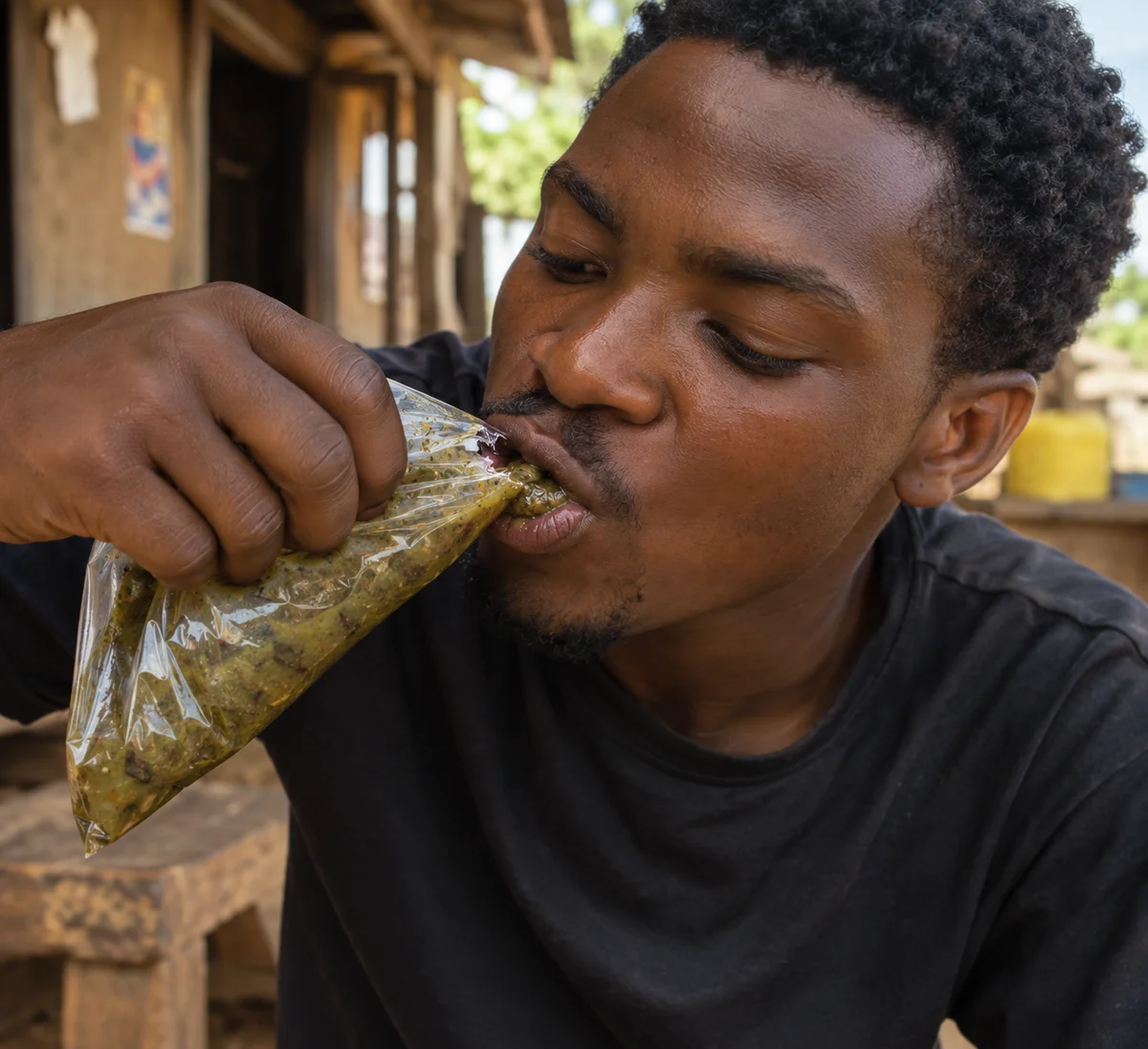
Take your daily hustle as an urban worker in Kampala. You’ve been sweating in the dust all morning, and by 2 PM, you finally scrape together just enough coins for lunch. You buy hot kikomando—steaming beans and chopped chapati—and the vendor scoops it directly into a cheap, flimsy kaveera (polythene bag). You tie it up, bite off the corner, and squeeze the food into your mouth to keep moving.


The heat from those boiling beans instantly leaches invisible, toxic chemical layers from that cheap plastic directly into your food. You swallow it, and your digestive system goes to work. But stomach acid cannot dissolve plastic. Instead, those microscopic shards—nanoplastics—pierce right through the delicate lining of your gut. They slip past your cellular defenses like microscopic shrapnel.


Once they break through, they drop directly into your bloodstream. They hitch a ride alongside your red blood cells, pumping through your liver, your lungs, and your heart. Slowly, day by day, they lodge themselves into the plaque of your arteries, hardening into a synthetic wall just waiting to trigger a massive stroke or a heart attack before you even hit fifty.


We used to think smoking was the ultimate slow killer. This is worse. It is vastly more fatal for one simple reason: you can choose not to light a cigarette, but you cannot choose not to eat.


This crisis is almost entirely out of hand. The rich are already pivoting. They can afford to buy their way out of the fallout with glass food containers, organic cotton clothing, and expensive reverse-osmosis water filters. But you? Your entire survival—your cheap synthetic shirts, your water tied in nylon pouches, your hot street food—is wrapped, served, and consumed in plastic because it is all you can afford.


This is a death sentence. You are becoming the plastic.

Feed attachment
Embracing vs. fixing flaws← Connected from
Open post →

Echoes the argument that cracks aren't meant to be fixed through Jajja Kintu's counsel to love what you already have rather than chasing mere repair.

X
XKMato
1d ago

The cracks of your past are the parts of your life's story that give you texture.
They're not meant to be fixed, but embraced.
They are a statement of your uniqueness.
They make you more than just another human.
They make you, you.
Look at you.
What are the odds that you're you?
Not one in 8 billion.
One of one.
You were always meant to be you.
Take the filters off your story.
They're not perfecting functions; they are disfigurations.

Jajja Kintu on 'Who called you poor?'← Connected from
Open post →

Reframes the 'Poor Sage' dilemma through Jajja Kintu's question—'Who told you that you're poor?'—challenging external definitions of poverty.

X
XKMato
4w ago

Poverty is the price of learning at your own pace, but Slavery is the price of giving up on learning.
We all lie somewhere on that spectrum.
Would you rather be a Poor Sage?
Or would you prefer to be a Rich Slave?
Rich Sage?
The extremes of the spectrum can sometimes distract you from knowing that you want what you want.
It is a trick in the language.
The Poor Sages of old called it a spell.
The duality.
Either this or that.
It's the first trick a magician learns:
To show you his empty palms,
While he hides the card behind his hands.
"Look, it's not in this palm,
And neither in that palm.
I made it disappear."
"Turn your hands around," the curious child demands.
And when the card isn't behind his hands,
The child believes.
Until his friend points out the rectangle forming in the magician's sleeve.
The card slid down the sleeve.
"The magician is boring," the friend screams.
But the child who fell for the trick
Has learnt the structure of all tricks:
That there are always more choices than the ones most obvious to him.
The friend became either a Poor Sage or a Rich Slave.
But the child became a Rich Sage.

Loving what you have← Connected from
Open post →

Balances the external duty to fight material unfairness with Jajja Kintu's inner counsel to question 'Who told you that you're poor?'

X
XKMato
1mo ago

It is easy for some to say, "Just accept that life isn't fair." if life isn't fair in their favor. For the rest of us, it is our duty to make life fair.

Redefines growth as loving first← Connected from
Open post →

Complicates reshaping the external world toward desire by arguing via Jajja Kintu that growth begins with loving what you already have.

X
XKMato
1d ago

On the experience of time

Growth is moving the external world closer to your internally desired world.
Aging is moving your internally desired world closer to the external world.

Manifestation is growing.
Imitation is aging.

You have to age as you grow, but are you growing more than you're aging?

Sign in to communicate privately with the author