
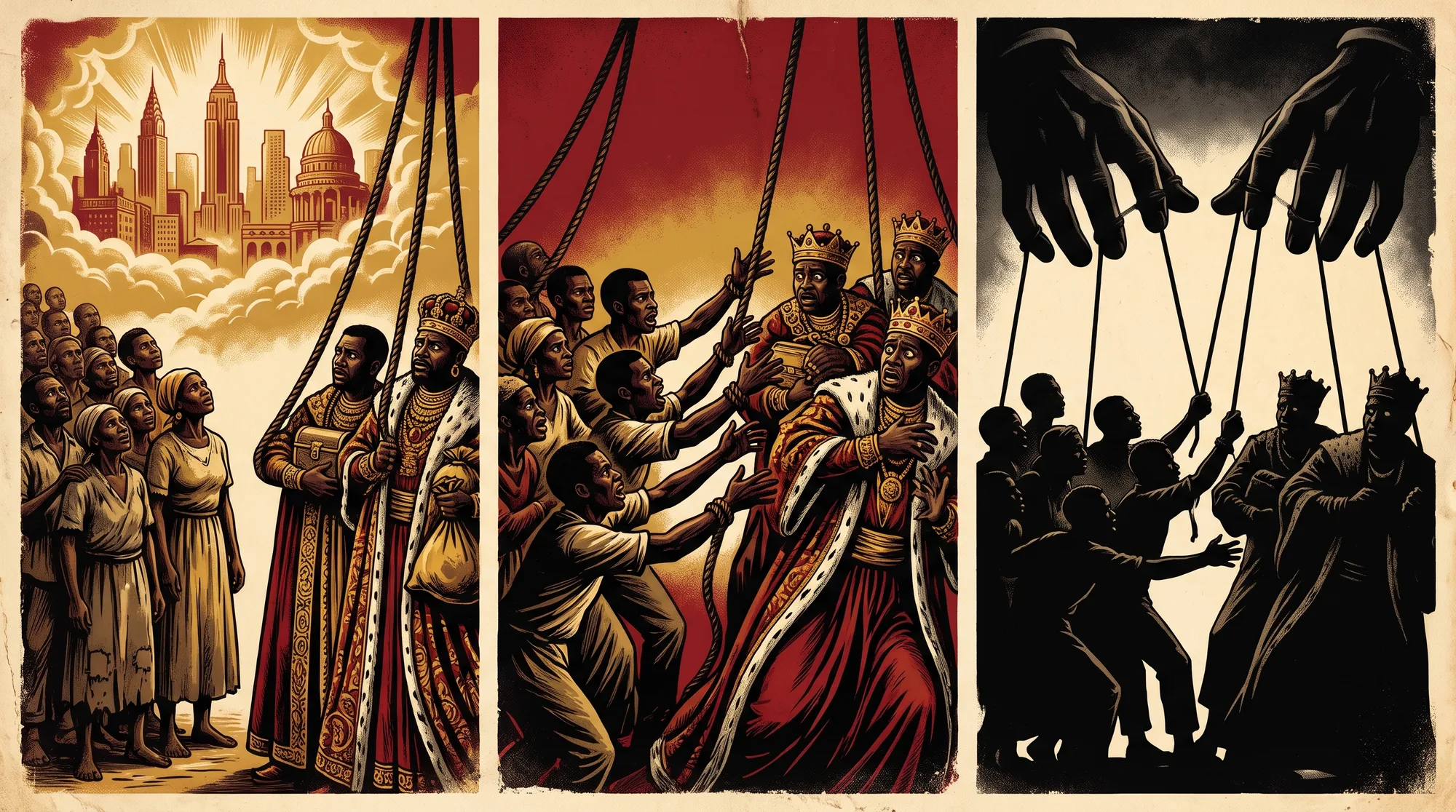
You could blame most of the social failure in African countries on one major blind spot in their leaders. And by leaders, I mean both the territory guards and their colonial masters.
There are societies out there that we admire mostly because we've been socially conditioned to admire them through advertising, propaganda (including education), and activism. Not to say that there is nothing in foreign societies that Africans can learn from, but the kind of admiration hypnotised into us makes us increasingly disgusted with our own societies and forces us to live in eternal wishful hope for these images of societies elsewhere.
And so, the main goal, especially through colonial education and religion, has been to convert the African into the kind of person who can build the foreign society that the African has been indoctrinated to wish for. I believe that it is in this goal that lies one of the biggest misunderstandings about the relationship between society and the psychology of individuals.
The mistake is in assuming that if you can produce the kind of individual that exists in a particular society, you can reproduce that society. But these are two very different things.
You can teach people to value punctuality without creating the social arrangements that make punctuality a reasonable expectation. You can teach people to respect the rule of law without creating a society in which the law is consistently experienced as legitimate. You can teach entrepreneurship without creating an environment in which productive collaboration is rewarded. You can teach people to be responsible citizens without giving them meaningful opportunities to exercise citizenship.
In other words, you can spend generations manufacturing individuals who exhibit the virtues of a society without ever producing the society itself.
This is because society is not simply a collection of individuals exhibiting desirable characteristics. It is a system of relationships, incentives, dependencies, expectations, and possibilities. It is something that emerges from the interactions of its constituents, and in turn becomes a force that shapes those constituents.
While stories are capable of making a sleeping body functional and compellable, the person itself, when awake, doesn't experience its selfhood as a collection of independent components. The individual is also a society in a sense, made up of other phenomena and forms that I am going to call micro-individuals because I am too lazy to think of a clever word. There is work in theory and hypothesis around genetics, cells, atoms, etc., and other "micro-individuals" whose existence today is known to a scientifically certain extent by humans.
And humans are to these micro-individuals what societies are to humans. Humans are made up of these smaller phenomena, and societies are made up of humans. In both cases, the whole becomes something more than the sum of its constituent parts. It develops properties, behaviours and capabilities that cannot be understood simply by examining its individual components.
A society, then, is a kind of macro-individual.
But there's an interesting distinction here. The cells that make up a human being collaborate in extraordinarily complex ways to sustain the life of the organism, most of which happens without the human being having any conscious understanding of how that collaboration works. In much the same way, humans collaborate, compete, negotiate and coordinate in countless ways that sustain society, often without any conscious understanding of how their individual activities contribute to the larger system. And just as we can study the human body to understand the relationships and processes that keep it alive, we can study society to understand the interactions and arrangements that sustain it. The interesting thing about humans, however, is that we can also become conscious participants in this process: studying the society we constitute and deliberately experimenting with ways to improve how we live together.
We create society, society creates us, and then we use the people society has created to recreate society. It is a recursive relationship.
And I think this is where Africa needs to redirect its attention.
If Africa wants to generate its own version of Manifest Destiny, Zhōnghuá Mínzú, or Russkiy Mir, the work has to be less about modifying individuals using mostly Western stories into this template of the civilized person, and more about learning the current African and building a society for the African as is.
And by learning the African, I don't mean coming up with some romanticised description of an African personality, or reducing ourselves to a caricature of some supposedly authentic African culture. I mean actually studying ourselves. Taking the time to understand who we are, how we behave, what we desire, how we organise ourselves, how we relate to each other, what we value, what we fear, what we are capable of, and how all these things vary across our different communities.
We can do this with mathematics, statistics, sociology, anthropology, psychology, economics, and whatever other analytical tools we have at our disposal. We should be developing increasingly sophisticated models of ourselves. Someone should be able to pull up a model that gives them some reasonable estimate of who Ugandans are in a particular region, culture, economic category, generation, or whatever other dimension they are interested in studying. Not a definitive description of the people, but an increasingly useful approximation of their characteristics, behaviours, relationships, needs and aspirations.
And we should be able to do this without pretending that people are predictable machines. Our models should accommodate uncertainty, diversity, contradictions and change. They should be capable of becoming more sophisticated as we learn more about ourselves.
Imagine being able to study Ugandan society as a complex adaptive system, with all its different cultures, social arrangements, economic activities, beliefs, relationships and individual aspirations. Imagine being able to ask increasingly sophisticated questions about how these things interact, where collaboration happens naturally, where it breaks down, and what kinds of arrangements might make it easier for people to work together.
This is knowledge that we should have been accumulating for generations. Instead, colonialism robbed us of much of the opportunity to study ourselves on our own terms by recasting Africa in the European image. We were too busy learning how to become something else to pay sufficient attention to what we already were.
But we can start now. We can start learning who we are.
And I don't want to preempt what this knowledge will eventually reveal about the kind of society we should create. It would be much better if the effort is less about a predestined nature of society that we want to be in, and rather about learning who we are today as a people and how best we can collaborate with each other. The society should become an emergent macro-individual that comes from this.
I think this is a much more persuasive direction than starting with an image of a perfect society and attempting to manufacture the people who can inhabit it.
I have been thinking a lot about this resurgence of panda gali and the recent direction in which some political spokesmen's propaganda is visioning Uganda, and it is clear to me that we've hit a stagnation in imagination.
We have allowed fear to lead the way as we traverse uncertainty over the future of Uganda instead of curiosity. We are doing everything we can to freeze Uganda into a society of the past that we understood very well and could control, rather than face the uncertainty of the inevitable growth that the future Uganda will bring.
I think this is an important distinction. The past is familiar, and familiarity can be comforting even when the things we remember weren't necessarily better. When people become uncertain about the future, they often become nostalgic about the past. They begin to associate what they understood with what was good, and what they don't understand with what is dangerous.
But a society that is constantly trying to return to a version of itself that it understands is a society that has stopped being curious about what it could become.
And this is particularly dangerous for Uganda because we are not just dealing with a stagnation of imagination in our political leadership. We are also dealing with a growing crisis of trust between the rulers and the population.
In a way, we are still recycling the same divide-and-conquer rule. We have a very vocal part of the population that is starting to doubt the capabilities of the rulers, and a very powerful part of the rulers that are starting to fear the intentions of the population.
So naturally, the population is getting louder as a way of demanding a bit more power to quench the doubt, but that is triggering the cruelty of the rulers instead, and they are attempting to impose fear into the population to silence the voice.
But this all boils down to a question of trust. One side is saying that they don't trust the other with power.
And the more interesting thing is that each side's behaviour is reinforcing the other's suspicions. The population interprets the cruelty of the rulers as evidence that they cannot be trusted with power. The rulers interpret the population's growing dissatisfaction as evidence that they cannot be trusted with power either. The result is a feedback loop in which distrust becomes self-reinforcing.
If this keeps taking the same turn, either those with power keep it using unimaginable cruelty, or the vocal part of the population takes it from them and is also forced to keep it with unimaginable cruelty.
And I think the solution has to begin with diverting all this energy away from haggling for power and into imagining and building the society.
The problem with much of our political discourse is that we spend so much time discussing who should have power that we rarely spend enough time discussing what we want to do with the society that power is supposed to serve.
The vocal population has to start communicating its vision. What does the ideal Uganda look like? What does it feel like to live in it? What kinds of relationships do people have with each other? How do people collaborate? What opportunities exist? What are the things people are able to do that they cannot do today? What kinds of lives are people able to pursue? What makes people want to participate in this society?
The rulers also have to do the same. What is their vision of Uganda? What kind of society are they trying to preserve or create? Why should people want to participate in it?
And the goal should be to persuade the other.
The rulers' goal should be to persuade the population that their vision is a valid and ideal vision. And I know this is hard to stomach, but the goal of the population should also be to clearly show that their vision works for everyone in Uganda, including the rulers.
We should at least be able to articulate a vision in which everyone has a meaningful stake and can see how their participation contributes to something worthwhile.
This is how we begin to resolve this stalemate or prevent it from becoming something much worse. The energy has to be directed towards doing the work to imagine a future that can accommodate all Ugandans.
And to be clear, this vision is not the final solution. It is the inevitable first step and the direction we have to take.
I am deliberately not rushing to talk about institutions, constitutions, economic models, or any of the other familiar artifacts that we associate with successful societies elsewhere. Not because these things are necessarily unimportant, but because we don't yet know what we need, what we don't need, or what we might need to invent for ourselves.
Those things should emerge from the work of understanding ourselves and attempting to realise our collective aspirations. We might discover that some of the things that other societies have built are useful to us. We might discover that some of our existing arrangements are worth preserving. We might also discover that there are things we need to create that we have never seen before.
But we shouldn’t begin by assuming that we already know what the answer looks like?
Uganda itself is the solution: a living solution that has to always be created for as long as it will live.
The vision, therefore, shouldn't be treated as a final destination or a blueprint that we must religiously follow. It should be more like a hypothesis. Something we put out there, examine, challenge, attempt to realise, and modify as we learn more. The actual work of solution-building happens when we start trying to achieve that vision and modifying it along the way.
In fact, perhaps the most important thing we can build is the ability to continuously discover better versions of Uganda. A society that can learn about itself, recognise when its arrangements are no longer serving its people, and reorganise itself without having to destroy everything it has built.
This is why I think the first step is manifestation.
Manifestation as the deliberate act of imagining something clearly enough that you can begin to organise your thoughts, actions and relationships around making it possible.
We need to start making the future of Uganda more tangible in our collective imagination. We need to give people something to see, discuss, challenge, improve and eventually participate in creating.
Instead, we are creating two artificial teams in one Uganda.
Whenever we make demands, complain on social media, or play the victim in whatever format, we risk conceding our agency to the rulers. And they know this, so they will slowly by slowly push us into a situation where we have to beg them. They've shown that they don't have a limit on how cruel they're willing to get. They literally got Andrew Mwenda to prophesy getting military men with sticks caning people as a way of enforcing traffic manners.
The plan is to make you into their victims. They could not get you to love them; they now prefer that you fear them. And if you keep dancing to their tune, they will get you there.
There is a lot of effort invested in keeping you passive and rulable. This effort is mostly effective when it keeps you analysing the past, reinforcing your insecurities and anxieties, judging others, or worrying about others judging you, and so many other tricks from the divide-and-conquer playbook.
Renounce Kasuku. Block him, in fact. His whole beef with Kazoora is just another gig aimed at keeping you asleep with petty interpersonal drama instead of analysing your society as a system. Anyone you hear saying that there is any one individual responsible for the failed state of Uganda, teach them that Uganda is a system, or block them.
Reducing the failures or successes of an entire society to the character of a few individuals is another way of avoiding the more difficult work of understanding how the system produces and sustains those failures.
The alternative is to build, and to collaborate.
Build with what we still have, because even that is going to be taken if we waste more time reacting. Write more. Discuss your ideas of a new Uganda more. Spend more of your time studying systems rather than indulging in entertainment that reinforces interpersonal drama. Spend time learning about the people around you. Pay more attention to your body; learn your thinking patterns and understand the desires that animate you, then write more about how those desires fit into your ideal Uganda.
And I don't mean that everyone should sit around waiting for some brilliant person to produce the perfect vision. The whole point is to get as many people as possible involved in this exercise. We should be producing competing visions, sharing them, arguing about them, finding common ground, and learning from the disagreements. We should be creating stories, essays, films, discussions, visualisations and whatever other media can help people encounter and participate in these imagined futures.
We should also be learning to study ourselves with the same curiosity we reserve for studying other societies. We should be collecting data, developing models, testing hypotheses, and continuously improving our understanding of who we are. There is no reason why the collective intelligence of Ugandans should not be directed towards understanding Uganda.
Redirect all that mental energy into imagining and refining the future of Uganda you want.
Yes, this is a skill that has to be intentionally cultivated. Society is a force on its own, and if it is directed towards keeping you petty, insecure, and anxious, it will take a lot of intentional effort to wake yourself into a creative force.
That distraction is a common witchcraft spell to keep you too busy to manifest your desires.
And perhaps this is the most important thing to understand: nobody has to have the complete answer before we begin. We don't need to agree on what Uganda should become before we start imagining it. We just need to start making our desires legible to one another. We need to put them out there so that other people can encounter them, challenge them, improve them, or find something in them that they hadn't thought of themselves.
The future is uncertain, and that's precisely why we need more curiosity, not less.
I have woken you out of the spell. Building Uganda yourself is not impossible. It is the only way.
So if you're reading this, the only political thought you should indulge is:
What does the ideal post-Museveni Uganda look like?
Don't just answer it in your head. Write it down. Make it tangible. Share it. Find other people who are imagining similar things. Find people who disagree with you. Let the ideas interact, mutate and evolve.
We have spent enough time being told what kind of people we should become. Perhaps it's time we started figuring out what kind of society we could create with the people we already are.
Manifest!
0 Comments