
A world in which Africa is healthy, prosperous, safe, strong, wise and friendly is a world where everyone is healthy, prosperous, safe, strong, wise and friendly.
In the global memory right now, Africa has suffered the most. From slavery, through colonization, and now into despotism, there is no society that has been exploited more than Africa. Yet it is precisely because of this history that Africa holds a special kind of empathy—and with it, a unique privilege of hope. If Africa can find her way out of the victim story, no other society anywhere in the world will be left behind. Africans have never built transcontinental, racialized empires of global extraction, nor have they ever set out to industrialize and outsource their pain across oceans to other peoples. Instead, Africa has learned to absorb this pain and accept it as part of its identity.
Unfortunately, for this exact reason, African society today functions fundamentally as a victim society—one perpetually looking out for some sort of messiah to liberate it from its suffering.
But consider the alternative: an Africa that decides to take on the burden of healing her own wounds and raising herself out of this infertile stagnation, instead of looking up to other societies as parental figures. That Africa stands the best chance of leading the world into a harmonious community of societies—one that understands the pain of exploitation and subjugation so intimately that it is incapable of wishing it on anyone else.
This is a task Africa can only take on through retrospection. If we as Africans keep looking to other societies, attempting to copy the moves they made to get to where they are today, not only will we forever be tailing them, we will also be forced to repeat their same cycles of oppression, subjugation, and exploitation in order to become those we envy or admire. Yet if we look inside Africa itself—if we really look—the way forward, while not straightforward, will inevitably show itself.
Take Uganda, for example. Because of this messiah reflex, a massive part of Ugandan political discourse has always been consumed by the personalities of our leaders. Be it Kabaka Muteesa I, whose tactical invitation to the missionaries inadvertently opened the door to the colonization of Buganda. Kabaka Muteesa II, framed as too elite or too weak to participate in politics pragmatically. Milton Obote, cast as cunning and deceptive. Idi Amin, passionate, cruel, and naive. Or even Museveni, whose strength lies in ambiguity and hidden ambition.
Spending the bulk of our intelligence analyzing these figures is a practice of idolatry. It distracts Ugandans from observing and understanding the actual society they want to improve. There are endless ways to analyze Ugandan leaders as uniquely strategic actors, each with his own strengths and weaknesses, just as there is a way to analyze them all as mere manifestations of a colonial puppet master. Either of these perspectives is almost entirely unfalsifiable. Therefore, spending any amount of time debunking one perspective in favor of another is a futile waste of intelligence.
Many of the moves made by our current leaders—their tactics, their ambitions, and their scales for measuring success—are informed by a primitive way of organizing social order: Ideology! This is the belief that one can theoretically reduce a living society into a neat set of beliefs, and then forcefully or cunningly fold that society into the shape of whichever ideology is most persuasive at the time. That is why you hear words like socialism, capitalism, privatization, and other God-sent conclusions that leaders feel compelled to manifest by folding the societies they lead into one of these forms.
These ideologies are factory-made solutions dreamt up by people reading books and enforced remotely through local leaders until the globe is made of groups of societies behaving in uniform, or at least extremely predictable, ways. The problem with ideology is that it is idolatrous by nature. It either pretends that whatever doesn't fit within its shape doesn't exist, or it asserts that whatever doesn't fit should be destroyed. And this approach to leading societies produces a never-ending conflict between tribes arguing over whose ideological idol is more divine. So we start with a prefabricated solution and attempt to panel-beat society until it becomes as close as possible to a system that can be perfectly predicted by this solution. For this approach to work, a leader only needs to be charismatic enough to sell the solution, or cruel enough to impose it.
To view ideology as a viable way of leading society, one has to be naive enough to tolerate two false premises: first, that human society behaves deterministically and can be shoved into a static structure; and second, that this structure has already been discovered, leaving us only the chore of fitting society inside it. This is why ideology is no more sophisticated than superstition. In fact, I would go as far as claiming that ideology is no more advanced a method for selecting leaders than whatever method chimpanzees use to find alpha males.
What if we took our attention away from the characteristics of the Alpha Males and the Ideologies? What if we diverted all the intelligence we currently waste on analyzing or worshiping idols—a practice shunned since the beginning of wisdom—and instead paid attention to our actual society?
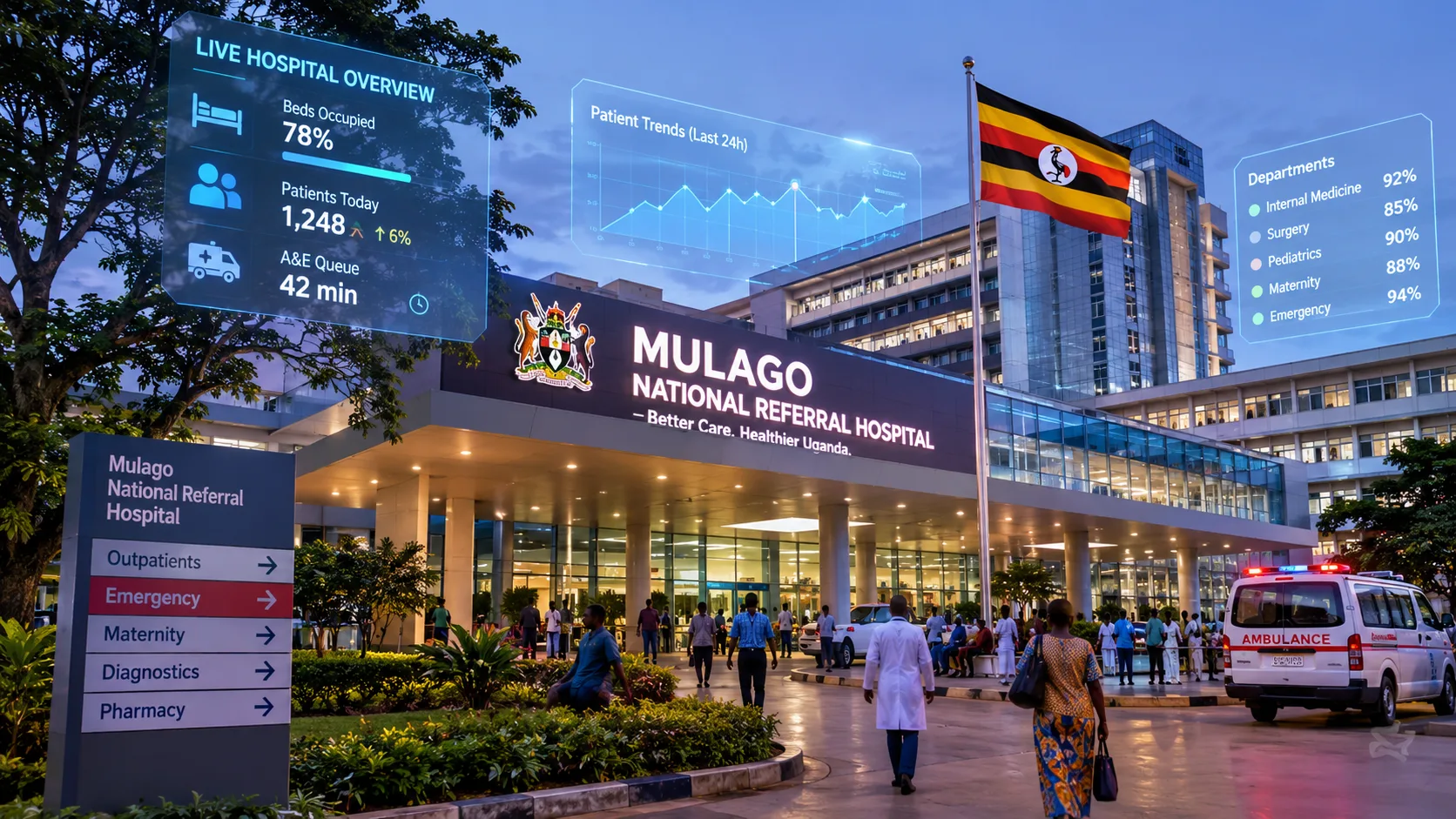
How many Ugandan political analysts know or can find out the exact number of patients in Mulago Hospital right now? How many know or can find out the specifics of the medicine in stock or the medical professionals on duty in Mulago at this very hour? Why does any political analyst or strategist think that debating a presidential promise would have a bigger impact on the state of Mulago Hospital than simply knowing the granular data points that clearly point to its specific bottlenecks?
Once upon a time, we did not have the language to know Uganda at a granular level, so comparing it to an idol—an ideology or an alpha male—was a reasonable proxy for measuring the state or potential of the country. That is why the modernist movement, which pulled intellectual-sounding words like socialism and democracy out of a hat like white rabbits, could be considered a form of progress—as long as the institutions that birthed modernism didn't trick themselves into believing they had reached the end of history.
Today, measuring the state of the country based on how close it is to socialism or capitalism is primitive compared to measuring and exposing the state of the country with as much granularity as possible, so that most stakeholders know with a verifiable level of confidence where the actual bottlenecks in the system we call Uganda are. Of course, the Alpha Males currently in power thrive on the political soap opera precisely because opacity protects their patronage; they have no incentive to hand over a clear dashboard of a broken hospital. That is why exposing the granular reality of our society cannot wait for official government PDFs—it has to be claimed from the bottom up by the citizens who actually experience the bottlenecks.
Having access to this level of visibility into the country is what complements and upgrades democracy into a useful system today. Instead of waiting five years for a popularity contest between rival alpha males, Ugandans can organize their leadership around creative, verifiable ideas on how to reconfigure order and resource management to resolve the areas choking the country. This is a version of democracy that doesn't need alpha males—or even traditional leaders—at all. We can transform Uganda from a social system led by the strongest or most popular figure into one where knowledge about itself incentivizes its stakeholders to compete on generating ideas that allow the system to grow itself.
This starts with persuaded analysts figuring out how to resist the temptation of viewing the country as a complex soap opera where personalities are fighting each other over spoils, and instead looking at the country as a system of flowing data points that can be guided—using the right numerical plumbing—into a system that works to serve the Ugandan.
John F. Kennedy once asked, "Ask not what your country can do for you—ask what you can do for your country." But I want to challenge the Ugandan elite today to invert that: to imagine a way to interpret and analyze this system we call Uganda where we, the stakeholders, ask, "Where can I modify the country today so that I can ask—or even demand—that the country do things for me?"
Not only do we have the language—Mathematics—today, we also have the tools: AI agents that allow us to build the digital infrastructure to track, monitor, and interpret data at a granularity and real-time frequency that flattens the learning curve. Instead of another top-down ideological theory, imagine an infrastructure where a nurse, a patient, or a supplier in Mulago can log a drug stockout or a broken machine on their phone in their own local language, and AI agents instantly aggregate thousands of these ground truths into a live, undeniable map of where the country is choking. That is what allows the majority of Ugandans to participate in building their country into a system that works for them. A democracy with actual agency.
My big bet is that the history of suffering carried in most African DNA, if coupled with the agency to build the future, will inevitably build the most empathetic version of the world—because a world in which Africa is healthy, prosperous, safe, strong, wise and friendly is a world where everyone is healthy, prosperous, safe, strong, wise and friendly.
0 Comments