
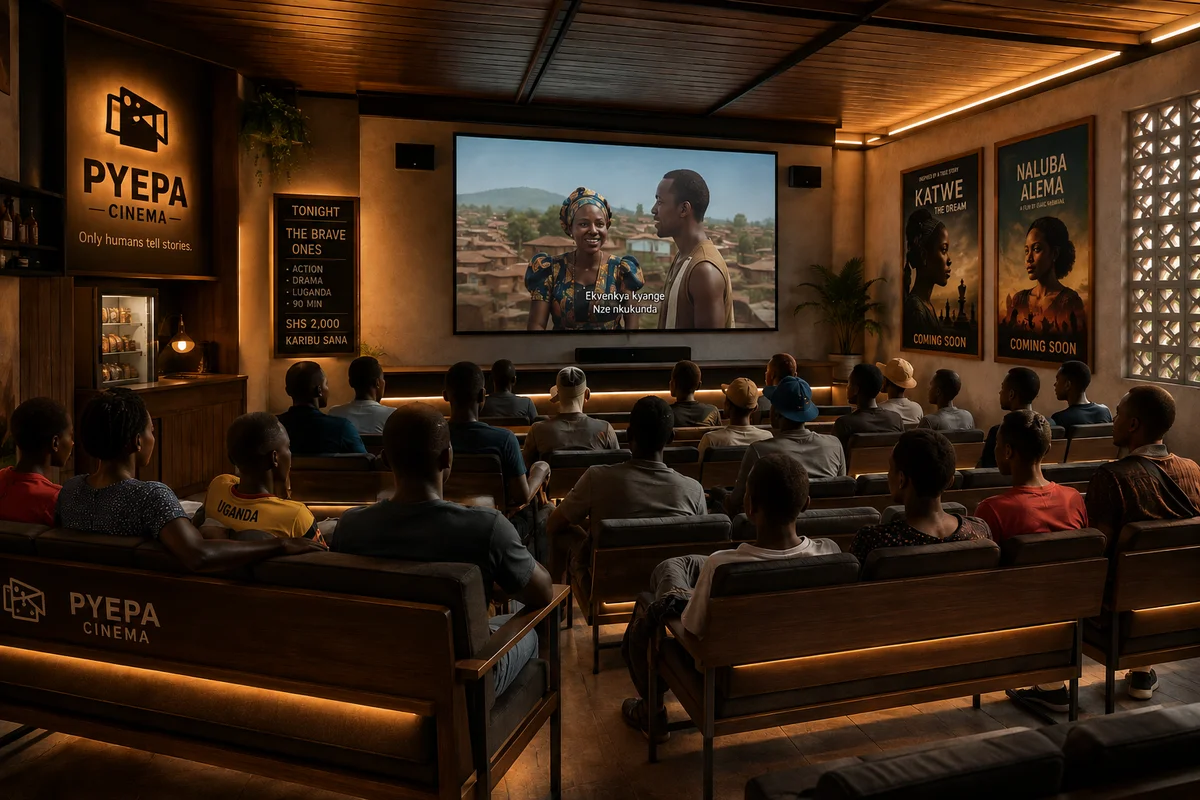
Having fallen into the same trap, I have realized that our limitation as film producers in Uganda, when it comes to distribution, is our obsession with polishing known methods into something profitable, rather than doing the work to create culturally relevant methods. This is why many of the classes teaching film distribution keep talking about cinemas, streaming, licensing, ticket sales, and strategies Americans used decades ago to get people to watch comic books slop.
For those who want to distribute Ugandan films, why do we even talk about cinemas? We have about four—if I am not mistaken—in the whole country. They are extremely capital-intensive, so it is unrealistic for a typical Ugandan business person to justify building one. Furthermore, a typical Ugandan might find the experience dull, preferring to watch a movie lying in bed, pausing occasionally to scroll through TikTok. The idea that a movie must be consumed the exact same way by 45 million people—sitting in silence for two hours staring at a screen—is a little bit of lazy thinking in my opinion.
Yes, this concept worked well in the BCE. But have we ever wondered why it worked? The obvious reason is the absence of smartphones, but another crucial factor is that those societies were more culturally centralized. Two families shared the same beliefs, two villages shared the same values, and in some places, entire countries spoke the same language. Some academics even argue that a good reason for the success of Western theater was for propaganda purposes—a lazy way of reducing diverse cultures into a governable, albeit domesticated, monolith.
But Uganda, like many other African societies, is not a monoculture. We speak more than 44 languages. Even among tribes with similar ancestral roots, we consider most of ourselves to be of distinct ancestry. We are so diverse.
When people ask, "What about India?" It is true that India is as diverse as most African societies, but the majority of Indian film is consumed by the Hindi monoculture. Bollywood is riding on ancient Hinduism's efforts to unite people within that region into a monoculture. Therefore, the success in India is not so much an outlier.
Our frustration with film distribution within Sub-Saharan Africa is actually a good insight into the limitations of importing social solutions. We treat social sciences like physics, using a statistical language, stripped entirely out of context and that very few of us understand. The side that believes they understand statistics better than the other weaponizes it to manipulate and take from the other side that doesn’t. It does this by enforcing statistics as the only tool of sense-making. And since they already mastered the "one true tool" of sense-making, what choice do we have but to follow them? For most of them, a future where the world is reduced to this one predictable monoculture that they can control is preferable to a more diverse society that is a little bit unpredictable sometimes. Now, I don't have a dog in this fight… I prefer diverse—wink!
So, if you live or believe in a society that functions better in diversity, but blindly copy solutions from people who lived or believed in societies that function better as a monolith, then you are most likely going to end up in the same stagnation that we see when it comes to film distribution in Uganda. Even if you believe that society functions better as a monolith but know that you live in one that currently functions as diverse, blindly enforcing these platforms and methods from societies you admire is, at best, going to be a waste of effort. What is worse is that you are going to build an aversion among those who don't share your beliefs. When diversity in society is based on aversion like fear, shame, hunger, hate, anger, delusion, or identity, it not only works against society, it makes it extremely difficult to unify that society into something close to a monolith without significant trauma. This is usually the role of propaganda.
We can attempt to blindly apply the methods that have worked well elsewhere by the force of wealth. We can spend billions of dollars—that could have fed and healed others—on marketing blockbusters. And in return, we trick the poor into spending even the little they have on making the rich richer. We can build cinemas, attempt to make movies that look and feel like The Avengers, host movie premieres, and award ourselves accolades like art is a competitive sport. We can do all the things in Uganda that make movies successful in Hollywood. But unless our goal is to create a powerful tool for mass indoctrination, political glorification, and distraction like Hitler did, only then should we aim to borrow Western mass monoculture tactics.
But if we simply want to raise our ancestors from the dead, if we want to tell funny stories about our friends, if we want to dramatically complain about our spouses, if we want to teach our children, then we have to do the work.
The first amount of effort is in learning who the Ugandan film consumer is. Cinemax recently got in a deal with Mariam Ndagire to distribute Ugandan films once every month in the EkinnaUganda in Cinemas initiative. If they make the mistake of making posters and pinning them on the theater walls, hiring ten influencers to talk about the films, and then pretending that they’ve done enough, Ugandans won’t come. That is, unless we have propaganda/advertising/activism-level amounts of money to scale the marketing. But if we use propaganda money to simply talk about how good the Ugandan army is. If we use advertising money to sell Coca-Cola, KFC, Fenty, and Guinness. If we use NGO money to preach against homophobia, domestic violence, and the devil. Ugandans will not come. Ugandans aren’t stupid. They are not willing to pay for you to sell them unnecessary anxieties and diseases just so you can come back and sell them medicines and messiahs. Propaganda, advertising, and activism at extreme scales are acts of mass violence. And if we want to use them as tools to create our cinema culture, then we should be extremely aware that they are swords that cut with both sides.
At Uvotam, we are building a film distribution platform called Pyepa. We want to distribute films to the people who exist right now. And within the platform, we want to learn what it would take for an average Ugandan today to want to go and watch a movie. We want to create a platform that does not assume what it can learn instead. We want a platform that doesn’t scale, but grows, like people and societies should. Using our skills in data engineering and content creation (including filmmaking), and also our passion for film, TV series, and content in general, we believe that we are the best people on earth—or any other place in the observable universe—who can create a distribution platform that can organically grow the average numbers of Ugandan cinema-goers and also incentivize the film industry to optimize for quality Ugandan film production.
For now, all we have to show for our efforts so far is this promise, our skills and passions, a short demo of the MVP on demand, and our short- and long-term plans. We believe that we understand the problem we want solved, and we also believe that we have what it takes to create a solution. Unfortunately, this kind of effort requires us to pay for compute and to hire a few professionals that we cannot afford right now. The point of this long essay is to ask you to share a bit of this effort with us.
If you are in a position to invest, please reach out to me. If you have a business, our website (uvotamstudio.com) shows all the services we offer. If you’re an activist and want to tailor your message to help more than it harms, we can work with you on campaigns for a reasonable fee. If you’re advertising a product or service that you truly believe will make the world a better place, we shall build an ad campaign with you for a market-competitive fee. Ms. Ndagire, if there is some ka budget, hire us to create a measurable marketing campaign for the EkinnaUganda in Cinemas initiative. If you are a government and are interested in applying analytics and automated intelligence within the social programs you’re implementing, we are open for business.
You should be skeptical of anyone promising to relieve you of effort, especially the hyper scalers; if they’re not scamming you, they are domesticating you. Nassim Taleb shared a parable to illustrate how past data can give a false sense of security before a sudden, catastrophic event: "Imagine a farmer feeds a turkey every single day. Each day of feeding increases the turkey's statistical confidence that the human race loves turkeys and looks out for its best interests. On the Wednesday before Thanksgiving, the farmer does not feed the turkey. Instead, he kills it. The turkey experiences a massive, fatal revision of belief."
The platforms and methods imported from the West carry in them past data; there is no guarantee that Africa is not just the Wednesday before Thanksgiving for the turkey. The actual effort has to be redirected into collecting actual data on African society and building our own living platforms that are redesigned to reflect new things we learn about our society. Most people I pitch this to are skeptical about whether we are able to compete with companies like Google in terms of data if our claim is that data is what makes a good platform. This is valid, but companies like Google are building something different from what we are building. Because of that, they are collecting a different kind of data than us. Google wants to turn Africa into a market or a product. And whatever machine emerges out of that effort, its primary function will be to create consumers.
Pyepa, on the other hand, wants to turn Africa into a home. We don’t see Ugandans as consumers; we see them as friends and relatives.
0 Comments