
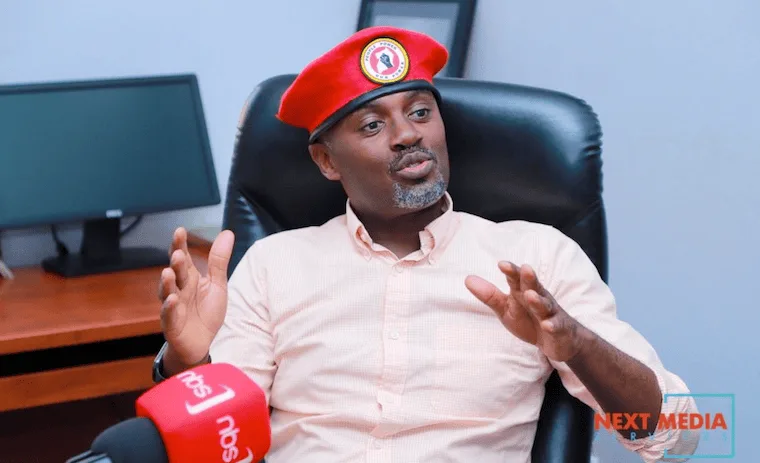
Andrew Mwenda starts almost all of his conversations by creating a strawman. Then he attacks it with his rapid, spitting chatterbox—a technique that exploits the politeness of his hosts, who hesitate to interrupt him thinking he is about to complete a point, only for him to pick up a completely unrelated thread and chatter away. It is a technique known in rhetoric as the Gish Gallop
In his recent conversation on Simply Legal about Uganda’s electricity blackouts and the Uganda Electricity Distribution Company Limited (UEDCL), this habit is on full display. He opens the interview by firing off statistics about Uganda’s total installed generation capacity since independence, river drainage at Karuma, and how it takes 20 years to build a dam. The host sits back, waiting for the connection to today's blackouts. Yet eight minutes later, Andrew casually admits that Uganda’s current problem is not that we produce or transmit less electricity, but that the distribution network is old. His entire opening rant was a strawman designed to sound authoritative before the actual conversation even began.
As a former journalist, Andrew uses good-sounding words, and I am almost certain he is not performing his submission. What Mr. Mwenda is suffering from is plain old stupidity disguised as intellectualism. Because he lacks training in simple mathematics, he is incapable of formal analysis. For someone to make a correct analysis, one has to establish clear axioms and follow them to a logical conclusion. Instead, Andrew mistakes his talent for telling convincing stories with actual rigor.
Nowhere is this bait-and-switch clearer than in his rant on public procurement. While the conversation is supposed to be about the failure in electricity distribution, Andrew indulges in typical populist banter—pointing out every place the government is inefficient and claiming that is why electricity is not supplied properly, without showing a single concrete example of how these inefficiencies actually hit UEDCL. He claims UEDCL was given $87 million to upgrade the network before taking over from Umeme, and asserts they have only spent $2 million in the past year. Why? Instead of citing a single blocked UEDCL tender or audit report, he invents a fictional worst-case scenario: "Me and you and him bid, I lose, I go to PPDA, that is 6 months delay... then IGG for 2 years... then State House Anti-Corruption Unit for 3 years. It can take you 6 years to procure transformers."
Notice the sleight of hand. UEDCL had only been managing the post-Umeme transition for one year at the time of his example. A hypothetical six-year procurement bottleneck cannot mathematically explain why money went unspent inside a single year. He never mentions whether UEDCL or Umeme actually suffered this specific delay when trying to buy the 12,000 to 15,000 transformers and 700,000 poles he claims they need. He simply leaves the assertion bare for the listener to trick themselves into assuming UEDCL tried to buy transformers and got stuck in a six-year loop.
Even worse is the contradiction at the heart of his political diagnosis. Somewhere in the middle of the banter, Andrew states that the reason government entities fail is because the President is misinformed by political manipulators. He gives his go-to example of a young man named Steven Wagaba, whom he claims mysteriously made his way into State House and fed the President fake, cooked information—tricking the President into firing his closest circle, including his personal assistant Elizabeth Agaba, his police head, and his aide-de-camp. According to Andrew, State House is surrounded by "wheeler dealers... like vultures surrounding an animal carcass" who have the President's ear, while the President himself has too many things to attend to.
Any sharp interviewer would pause the show right there, because that claim implies the country is suffering from a far bigger problem than electricity supply. If the President can be easily duped into firing his own inner circle by a random operative, the executive branch is compromised. But the chatterbox has already pivoted to another topic—and four minutes later, he delivers a solution that completely blows up his own premise.
What is Andrew’s grand recommendation to save UEDCL?
Liberate UEDCL from PPDA procurement rules.
Strip away all oversight from the Inspector General of Government (IGG).
Stop the Auditor General from auditing them and hand it to a private firm like PwC.
Give President Museveni (or Muhoozi Kainerugaba) the extra job of personally micromanaging the UEDCL CEO on the phone every single day!
Think about the sheer absurdity of that logic. He spends ten minutes arguing that the President is overwhelmed and surrounded by vultures who trick him with fake information, and then recommends that we create a government agency with zero government oversight and hand its daily supervision directly to the same overwhelmed President. To prove this works, he points to the oil sector in the Ministry of Energy, bragging about how the President gave geologists a direct phone line and insulated them from politics. Yet within thirty seconds, his inability to filter his own thoughts forces him to admit that this exact oil team "lost the big picture" arguing over pennies, and that the President "has lost the ball" on oil and is stuck with a refinery contractor that has been given two extensions and is going nowhere. He undresses his own argument in under a minute without even realizing it.
When he tries to use actual math, the wheels come off completely. Attempting to sound like an unconventional thinker, he argues that whether a government official takes a bribe is "irrelevant" as long as a road is built. He sets up a laughable mathematical scenario: if a contractor bids 100millionforaroadwitha10%profitmargin(10 million), and adds a $3 million bribe on top, the new price of $103 million falls within a normal bidding variance of $100 million to $105 million. Therefore, Andrew declares, a $3 million bribe is "statistically insignificant"—or perhaps the contractor is so generous they will pay the bribe out of their own profit!
He throws around the phrase "statistically insignificant" because he thinks it sounds smart, completely oblivious to the fact that $3 million in stolen public funds buys hundreds of those transformers he was just crying about. Moreover, just four minutes earlier, he was complaining that "every road contract in Uganda is inflated" because officials hide behind procedures to steal. He cannot connect the axiom that bribery exists precisely to rig the price, quality, and timeline of contracts.
To justify throwing out all modern anti-corruption rules, he retreats into bedtime stories about his father in the 1960s and 1970s. He narrates how his dad was a treasurer in the Public Works Department in Toro District, driving around in a Land Rover with a police officer and cash to pay workers, or coming to Kampala to fill a trailer with spare parts with "no oversight" and "no controls," relying purely on personal integrity. Seconds later, he admits: "That's the kind of civil service we had in the 1960s and 1970s, but we don't have them anymore... today the culture is for stealing." If you admit the current system is full of thieves who lack your father's 1960s integrity, how on earth is your solution to abolish the PPDA, the IGG, and the Auditor General?
I could barely muster the patience to sit through the whole banter, but there is value in writing this down to raise awareness among those who still insist that Andrew Mwenda is smart and simply supporting the wrong team. Yes, I am talking to you, Kabuleta. You are not paying attention. Andrew is not being coerced to work for anyone—he is exploited based on his desperate craving to sound intelligent. The people around him make him feel smart. I doubt they actually believe he is smart; they just know that if you give him a seat at the table and nod at his stories about Toro Kingdom, German bond yields, and Chinese cement statistics, you can get him to defend anything—including the idea that $3 million bribes don't cost the taxpayer a shilling. You know, like how you use treats to train a dog.
Anyway, I would like to officially invite Andrew Mwenda to the Uvotam Podcast to discuss any topic of his choosing. He has insulted Besigye before so he should not expect me to be nice to him. I will give him a class in self-awareness. Hopefully, that is the lesson he needs to finally correct his sight.
1 Comment
I will share the simply kegal guys number so you try and set this up