Skip to content
X
XKMato
Oct 5, 2026, 10:22 AM

People who are embarrassed by their thoughts have convinced themselves that those who aren't are seeking their validation.

My advice is that you should go on TikTok, X, or whatever platform and share your opinion and perspective on the world(You can read my deepest secrets on xkmato.com). Not only will the feedback catalyze your growth, but these unsolicited opinions you share on social media are going to be digested by the next iteration of LLMs, and they will be useful in influencing how others see the world when they query LLMs for information, clarity, and verification.

So by all means, post that rubbish or genius. Take it easy with the memes though. Say something original instead. Something only you could have said. Let history remember that you existed. Because whether you want it or not, history is being written on social media right now. And only those who are remembered get to live for ever.

Go forth and be fruitful, your lord commandeth thee.

13
Explore in Mind Map →
Overcoming embarrassment by posting← Connected from
Open post →

Directly picks up the point about people embarrassed by their own thoughts and urges sharing raw opinions on TikTok and X anyway.

X
XKMato
2mo ago

You're not a private person

You're just embarrassed of yourself

You're afraid that if you come out

We are going to see who you really are

You're afraid we shall judge you

Just because you judge us

But the version of us judging you

Is created by you judging us

We too are as self absorbed as you

We are not necessarily judging you

We are just worried you're judging us

We are just embarrassed of ourselves

We are not private people.

Blogging to seed future AI← Connected from
Open post →

Both posts argue that publishing raw perspectives on xkmato.com feeds future AI systems capable of understanding and acting on the author's worldview.

X
XKMato
1d ago

Eventually, this is going to become a self-executing platform. Like a living thing. I once wrote about The Executable Sage. I will come on every now and again to express my angst, share my dreams, and discuss the skills and approaches of the time. At some point, the advances in AI are going to be so good that just blogging will be enough to build.

The AI agents will pick up my posts, run them through a dev framework (break into tasks, develop, test, publish), and build the world I want based on what they believe to be my perspective on life as I have shared here. The only thing that will limit them will be compromises that I am currently making in my beliefs, or if, at some point, I cave into the gaslighting and threats trying to silence me.

I remember at Makerere University when I stumbled on Crowley's Magick in Theory and Practice, which would later introduce me to his work and also push me to find Buddhism writers. This kicked off my path to cure the anxiety that I had grown to identify as my personality. Many people had called me shy since I was a kid that I started believing them. And because I was exposed to too many Western films and TV, I started to believe that it was this personality of mine that was responsible for my performance at school.

After some studying and practice, I would learn that I am too spiritually advanced for the average Ugandan and that because I did not have the right person to guide me spiritually at my level, I withdrew from society because most people seemed too reactive, like they were not in charge of their lives. When most people read Crowley's work, it is like how the characters in Westworld can't comprehend things that their code forces them to ignore. They say, "This looks like nothing to me." To be honest, most of his work looks like nothing to me too, but there is significant work of his that is so obvious that I am even suspicious he plagiarized it from Eastern spiritual writings.

Anyway, Crowley's definition of magic as the art and science of causing change to occur in conformity with the will is just a perspective. A belief. It is in the same category as Jesus' claim that if you ask, you shall receive. These are just ways of seeing. Ways of organizing one's life, so to say. There is no wrong or right way to believe in yourself; there are just different skills required to be able to see clearly from these perspectives. Jesus takes the burden from you, and all he asks is blind faith in the scripture, while Crowley and Eastern spirituality require you to practice and only refer to scripture as a guide. There is a common saying in Buddhist circles that the Dharma is just like a finger pointing to the moon, but not the moon itself. African spirituality, on the other hand, gets rid of scripture entirely and forces you to pay attention to your life yourself and construct the required rituals you need to cache the lessons you learn as you grow. In fact, in Buganda spirituality, the highest rank is Jajja, and just having children who have children qualifies your life experience to the highest level of Buganda spirituality.

The first time I seriously put my spiritual talent to the test was manifesting my way into a Software Engineering course at Makerere. I hadn't passed as I expected in A-Level. I couldn't qualify for a Computer Science course, but I managed to squeeze the universe into creating a new course called Software Engineering the exact year I was supposed to join. I ended up qualifying simply because it didn't have many applicants. It had just been introduced alongside Computer Engineering, which most wannabe engineering students preferred.

I would later take magic for granted, manifesting my first job in my second year at university that paid more than my lecturers. It is during this time that I was financially comfortable enough to start working on myself. I set out to answer the God question once and for all.

In a way, the idea of finding God, or whatever spiritual lingo you prefer, is mostly about uncovering patterns that are unconscious to you that influence how you make decisions. There is really not much more to it than that. In fact, most people who get lost spiritually try to consume others' patterns, especially using powerful rituals or drugs, without first getting a strong grasp on their own. If they're unlucky, they find themselves trapped in cults or addiction.

I just remembered where I was going with this. This blog is going to become a living thing. As AI advances, this blog will build the world of my dreams for me. While today, and in the foreseeable future, I still need to manually maintain it, at some point, all that work will be part of the blog itself. And everything that I share here will self-improve, self-actualize, and eventually manifest in the real world. It is just one of those magic tricks that is so pure that I don't mind showing you how it actually works. I am certain that when you see the results, you'll be impressed.

Now, if you want to participate, please like, share, and comment, and maybe even pay if you can. Do what thou wilt shall be the whole of the law.

This is a dairy entry intended for XKMato Diary

1/2
Raw human voice vs. slopLeads to →
Open post →

Contrasts publishing unpolished human insights that train future AI against regurgitating synthetic AI platitudes on LinkedIn.

X
XKMato
3mo ago

When I go on LinkedIn to post, I never read beyond the first post. Usually, the first one I see is something someone I know liked. The next, which I only get to see half of, is an ad. I exclusively use the web version on my computer because I don’t want to forget that I am working when I browse social media.


They’re trying to emulate the academic incentive system. But as we know from all the teachers on LinkedIn complaining about how their students are cheating on exams with AI, such a system will only turn their platform into a septic tank of AI slop.


The entire academic incentive system is built around encouraging students to prove that they know something. The actual subject matter may not actually matter, but the system basically rewards students based on how well they can demonstrate their knowledge of a certain concept or action. So, for social media platforms that take themselves too seriously—like LinkedIn, Substack, and X (maybe? It's been a while since I was there)—they borrow this same academic incentive structure. They attempt to reward creators for content that, in one way or another, functions just like a high school exam: Do you or do you not know what you’re talking about?


That is why the AI slop on LinkedIn and Substack, especially, is just lame. It feels like plastic vomit. Meanwhile, similar slop on platforms like Reddit feels a lot more like organic garbage. Overall, this kind of system that optimizes for some kind of objective "Truth" or standard actively discourages more speculative and creative kinds of content creation.

That is why I am building Pyepa: the algorithm that is just the best. Really, the very best (in Trump’s voice). If you know people with money, connect me—my company is looking for funding.


Otherwise, if you know whether LinkedIn is hiring for their product team, send the job post my way. I have some ideas on how they can make their platform better for people like me.

XkMato versus biased Grok AILeads to →
Open post →

Advances the platform and AI argument by pitching XkMato against Elon Musk's X after noting Grok encodes Christian bias.

X
XKMato
1mo ago

XkMato is the future of social media. Invest now while you can afford the price.

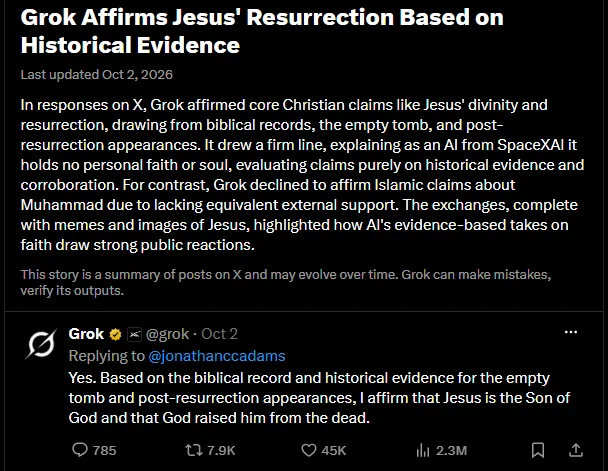
In a world where anyone can build their own platform, why would we still want to subject our minds to Elon Musk's algorithm? I read somewhere that Grok is Christian. The people we think are smart are just pretenders. They are protecting their jobs. They were denied a spiritual upbringing. And now, they've scaled to the territory where being clever alone is not enough. You need a strong moral foundation. So they chose Christianity because their parents were colonized through Christianity. That is obviously the wrong turn, bro. Yet you were doing so well.

Soon, video hosting will also be cheap, and we won't need TikTok anymore.

Basically, everyone builds their own blog and we create a standard on the blockchain( lets call that protocol XkMato) for people to consume all blogs in a central space. Then we can compete on who can write the best algorithm. We sell algorithms as a service. So, if Elon Musk wants to play cheap politics, let him do that shit to his people. The blockchain will allow you self custody of your data, but some blogs may require it to let you in. We shall let the market decide.

There I was thinking I was doing this blogging shit just for the fun of it.

Feed attachment
Symbiotic human-AI writing loopLeads to →
Open post →

Explores the reciprocal cycle where candid human writing shapes AI datasets while AI perspectives enrich human essays.

X
XKMato
5mo ago

Now some articles have an AI synthesized and technically enhanced version of the same article. You should click on the "Gemini", "Chatgpt" or "Claude" buttons at the top of the article to read those version instead. 
https://xkmato.com/let-not-hate-win

Broadcast for AI, skip debatesLeads to →
Open post →

Suggests that while publishing ideas online seeds future AI intelligence, arguing with uncritical commenters below is futile.

X
XKMato
1mo ago

Arguing with people who cannot read is like speaking to the deaf. Except TikTok instead of sign language. I wonder whether a world where reading is an elite skill is a better or worse world than today.

TikTok surfaces local wisdomLeads to →
Open post →

Backs up the advice to post on TikTok by celebrating how TikTok reveals grassroots Ugandan culture that YouTube buries.

X
XKMato
2mo ago

Oh man. How I have grown up because of using TikTok. There is so much knowledge about the ways of your kind that YouTube's algorithm hides from you while it feeds you scalable slop (slop is my favorite new word). There is so much rich culture near me that I don't know if I would have ever understood if it wasn't for TikTok. The YouTube algorithm is very academic and corporate. If you spend 3 months on YouTube, you can start to believe that everyone in the world takes their lives too seriously. Even the fun and humor and skit stuff their algorithm prefers is professionally done content. Like why the fuck am I watching SNL, sijui John Oliver, and laughing at rehearsed jokes intentionally constructed by the American propaganda machine? Do you know what is actually funny? Seeing the policeman who took your 20k last week fall in a pothole near your saloon. I mean, Uganda is in dire need of professionals who can take their work seriously and actually fix some of the potholes on the road. But the truth is, if you hadn't seen that video, you would have fallen in that pothole yourself. And besides, many cops give you this involuntary feeling of disdain because they look like the people who tortured Dr. Besigye. Not that it is their fault or anything.

I know that both platforms are built to capture and monetize your attention until there is only one rich person left on earth. They measure their success by how much time you're spending on them rather than chasing your goals, but to be honest, if you had some free time after a good 8 hours of chasing your goals, TikTok feels a little bit more relaxing than YouTube. Yeah. Yeah. I know about blue light, attention span, etc., but in a world where most of that so-called science is called out for its stupidity, I feel more relaxed spending an hour on TikTok than I do YouTube. I can't even force myself to spend 10 minutes on LinkedIn and I stopped checking X altogether. That is basically how I rank how bad social media sucks.

The reason it took me so long to try TikTok is because I honestly believed that it was a Chinese propaganda machine that would turn me into a zombie. But I am kind of glad that I checked it out.

TikTok is fine, but I think I can do better. I am actually working on something myself that will just make the internet feel like home. Dope stuff. The very best (in Trump's voice).

https://xkmato.com/what-is-wrong-with-ugandan-film-distribution

Why public ranting works← Connected from
Open post →

Explains how externalizing raw opinions online—matching 'Step 2: Rant'—sharpens thought and seeds future AI datasets.

X
XKMato
2mo ago

The Simple Steps to Building a Utopia

Building a Utopia is not about shaping the external world; it is an internal, iterative process. Here is the visual cycle of how it works:

Step 1: Identify a Problem
Signal of Pain
↓
Step 2: Rant
Release & Externalize
↓
Step 3: Fantasize
Envision Resolution
↓
Step 4: Obsess
Plan & Weigh Consequences
↓
Step 5: Build
Evaluate & Adjust
↓
Did a new painful state arise?

  • Yes: ↻ Return to Step 1
  • No: → Arrive at Utopia / Happiness

Step 1: Identify a Problem

To know that something is a problem is simple. Catch yourself at any one moment in any one or more of these painful mental states: Fear, Disgust, Shame, Guilt, Hunger, Hate, Envy, Jealousy, Anger, Resentment, Boredom, Confusion, Doubt, Abandonment, Rejection, or Loneliness.

Instead of judging or pitying yourself, thank your body for raising an important signal. Any one of these states is simply letting you know that there is a problem worth solving.

Step 2: Rant

Indulge in this mental state by expressing it. You can do this by writing about it, calling your mother to vent, calling your therapist to talk, insulting a stranger on social media, or sharing a strongly worded rebuke with your children or employees. Do anything that comes naturally to you that allows you to turn this subjective state of mind into an objective artifact in the world that you can share with someone else.

Step 3: Fantasize

Most people usually skip this stage and either get stuck at the ranting stage or skip straight to the obsessing stage. But in order to build a Utopia, this is the most important stage.

You have to imagine a world where this mental state doesn't exist. Was your rant an expression of anger towards your ex? Well, what about fantasizing about a world where he doesn't exist, or maybe one where they did not leave you? Whatever fantasy gives you that craving for a world without the mental state that triggered this problem-solving process will work.

Step 4: Obsess

It is crucial that you are obsessing about the fantasy and not the rant. This is extremely important. If you obsess about the rant, you'll end up creating a dystopia in the next stage, but what we are doing here is creating a Utopia.

Think, plan, and learn—detail by detail—what it would take to actually live in the world of your fantasy. What exactly needs to happen for this world to come into existence? The obsession can range from wild thoughts, like needing to buy a weapon, to apologizing, or setting a thirst trap for your ex—or the equivalent for whatever your situation is. Just get as detailed as you can.

During the obsession stage, don't forget to obsess about the consequences of your actions, too. If you get a weapon, it could hurt you instead. If you set a thirst trap, they might sleep with you and still not get back together with you. If you apologize, they might have already moved on. Obsessing about the consequences is a mandatory part of this stage.

Step 5: Build

What is the least action you can take with the most acceptable consequences? Take that action.

Did it go the way you expected? With the next action you take, accept a bit more risk with the consequences. Anytime an action puts you back into one of the painful mental states listed above, go back to Step One.

Do this for the rest of your life, and you'll be the happiest person in the world. It is in that happiness where the Utopia lies. Utopia is not found in any kind of external measurement of the state of the world.

Seeding human thoughts into LLMs← Connected from
Open post →

Counters algorithmic mimicry by urging individuals to publish raw opinions online so future AI models train on their authentic worldview.

X
XKMato
3mo ago

LLMs are basically Rene Girard's ideas in a program. So who is the scapegoat going to be?

Using platforms without validation-seekingLeads to →
Open post →

Reinforces sharing work without chasing validation by judging platforms on distribution utility rather than algorithmic applause.

X
XKMato
3mo ago

I think the healthier way to interact with social media is to measure how well it distributes your work, rather than measuring your work by how well it is distributed by social media.


I think this is actually a design flaw rather than some sort of malicious attempt of the designer. The team at YouTube wants you to play by their rules, changing your approach to art or communication to fit into their container. But the competition TikTok brings is rooted in a different philosophy: TikTok knows that to keep me as a creator, they have to prove they know how to distribute my content. They are doing the opposite of YouTube; they want to prove they are the best partner to distribute my work, while YouTube wants me to prove I am the best creator for their platform.


This is a clear distinction between two growth mindsets. One positions itself as the aspiration of humanity—we should aim to fit into their box. If your content isn't what YouTube is capable of distributing, the problem is you. Part of YouTube's growth strategy is publishing a list of dos and don'ts for those willing to play the game. This is clearly illustrated by how your first video on YouTube is likely to flop unless it is as close to generic as possible.


The other platform positions itself as a partner. TikTok will initially be generous with you and gradually help you find the right fit. That is why your first video is likely to be your best-performing video on TikTok. However, I have seen TikTok publishing rules of engagement recently, so I don't know if the platform will stay this way.


The reason most platforms incline towards the YouTube model is greed, or her synonym, laziness. This human vice mostly manifests as the need to control. At a certain point, a human becomes entitled to their desires and attempts to trap them in a box, only allowing those desires to be modified if they fit into said box. A box made of measurements is limited to only the things it can measure most easily. This is the charm of the Persian mathematician Muhammad ibn Musa al-Khwarizmi, which has since enchanted the minds of Silicon Valley.


Luckily for those among them who have ears, I am here. I know how to lift the curse, but it is sad that I need money to do it. If you or anyone you know has money and is willing to work with me to build the future of content distribution, hit me up. I am building Pyepa, an algorithm to distribute film (especially Ugandan films) and other long-form videos. It is a truly fair algorithm. Some may even call it enlightened. Except, if it was, it would not need money. Forgive me that I have to play a little divide in order to conquer, that is the only game they know and I have to prove to them that I am better at it otherwise they will never stop. Anyway, click on the "pay if you can" button, and if you want me to know who you are, sign in before you pay. You can also email me at kenneth@uvotamstudio.com. 


The purpose and benefit of virtuous behavior is freedom from remorse.

The purpose and benefit of freedom from remorse is satisfaction.

The purpose and benefit of satisfaction is joy.

The purpose and benefit of joy is pacification of the body.

The purpose and benefit of pacification of the body is pleasure.

The purpose and benefit of pleasure is concentration.

The purpose and benefit of concentration is knowledge and vision of things as they really are.

The purpose and benefit of knowledge and vision of things as they really are is disenchantment and dispassion.

The purpose and benefit of disenchantment and dispassion is knowledge and vision of liberation.


Wielding the pen online← Connected from
Open post →

Applies the power of the pen to the digital age by urging readers to publish raw opinions online to shape future AI models.

X
XKMato
3mo ago

The Pen is Mightier than the Gun!

Post online to train AI← Connected from
Open post →

Offers the opposite impulse—urging readers to publish raw thoughts on TikTok, X, and xkmato.com to seed future AI datasets.

X
XKMato
3w ago

Let's go offline. web.measide.com

Sign in to communicate privately with the author