
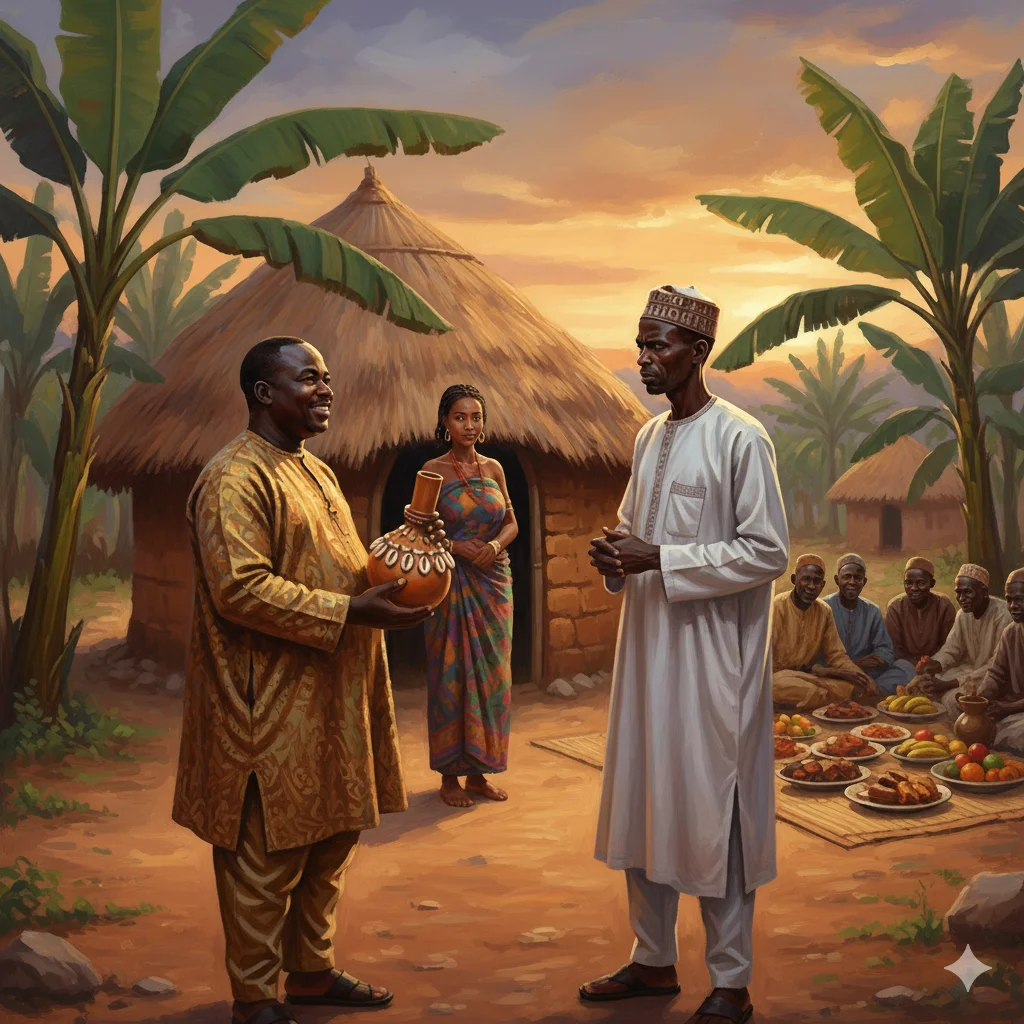
It started as a simple quarrel. Mr. Katongole’s goats had gone wild again, eating the newly planted leaves from the Bisasos’ lumonde garden.
When the village elders sat to discuss the matter, they gathered at Mr. Katongole’s home. Katongole was a man even his enemies praised for his hospitality—some would say his charm was such that he could bed your wife and you would still remain his friend. Before leaving home for this meeting, Mr. Bisaso had sworn he would not be tricked or seduced by fine food or glittery objects. He was there to discuss a serious matter: how Katongole’s animals had become a burden to the village. Bisaso had even insisted that his wife serve him supper before he left, fearing there could be charms in Katongole’s food that would soften his resolve and make him accept a truce.
Mrs. Bisaso laughed, insisting that one sip of mwenge bigere was all it would take for Katongole to get off scot-free. “I will not drink,” Bisaso declared. Mrs. Bisaso knelt with a jug of water, placed a katansa under her husband’s hands, and poured water over them as he licked his teeth and lips. She noticed he had also encroached on her side of the matooke on the lusania. She was always happy when her husband ate more of her cooking, although she wished it was because of her excellent cooking and not as a vaccine against his nemesis’s charms.
Bisaso shuffled through the basket of fruits and foods his wife had packed for him as an offering to Katongole. He saw a small dark spot on one of the bananas. “Why don’t we swap this bunch for a cleaner one?” he asked his wife.
She came and investigated the fruits, then laughed. Having an enemy is harder on the hater than the hated, she thought.
“On top of all the destruction the man is doing to our property, we don’t want him to pity us as well,” Bisaso clarified.
His wife knew that Bisaso secretly enjoyed these negotiations, not just because his compensation was guaranteed but also because he got to enjoy the hospitality that Katongole generously offered. She had even heard rumors that Bisaso conspired on this last offence but knew that kind of behavior was beneath her husband.
When people visited Katongole, they often never left. If a villager had a problem with him, Katongole would simply throw a party on the same day as a major event planned by that person. “Katongole amuzemu” (Katongole has responded) was often echoed if someone threw a party to celebrate a new wife or a newborn and few people came. The first thing anyone would ask was what was happening at Katongole’s, and most of the time, they would be right: Katongole was throwing a parallel party. This forced most people to invite him first. They would find out if they were on good terms with him through one of his wives and make sure to get a confirmed acceptance before they organized anything.
The one time a party was thrown without Katongole’s approval was when Bisaso’s eldest son returned to visit from the great lakes, where he lived among the Arabs and Baswahili. The son did not know about the protocols of hosting events in the village. When his mother realized her son was set on throwing a party without first checking with Katongole, she tried to stop him. She warned. She threatened. Nothing worked; the son had his father’s temper. They were both most stubborn when they needed to be pragmatic.
So, Mrs. Bisaso started a rumor. She said her son, who had never married, had lost his wife in the great lake in Mombasa. That he had come back to grieve because the waves had carried her body to the spice lands of the Indians. The rumor continued that the only reason he wanted to throw a party was that he did not want to burden the people he had long abandoned with his grief. And that he intentionally did not call Katongole because he was hoping few people would come—only those very close to the family so he could confess his trick and allow them to grieve with him. The mother thought this rumor would at least guarantee the presence of her closest friends and relatives and help her save face.
To her surprise, the rumor was much more effective than she had anticipated. The whole village showed up. Initially, she thought Katongole had also fallen for the rumor and decided not to throw a party out of respect for the dead, but she later learned that Katongole had indeed thrown a party, and for the first time in his life, it had flopped. During her son’s party, the mother approached her cousin to confess. “I know this makes me the worst person in the world, but I had to start this rumor. I did not want my son going back to live among those foreigners with resentment for his home. I am embarrassed, but I don’t regret it.”
“You don’t really think the whole village was stupid enough to believe this rumor of yours?” the cousin asked. “One day you hear there is a party at Bisaso’s, the next day you hear Katongole was not invited, and the day after that you hear the party is a vigil. How stupid do you think the people of this village are? Everyone here knows. People just needed an excuse to skip Katongole’s party.”
Yes, the man was a great host, but the village was starting to worry about the monopoly he held on when and how events were organized. The vigil was the perfect excuse, not for the Bisasos, but for the guests. Before this ingenious rumor, everyone was worried that skipping Katongole’s party was a sure way to put oneself in his bad books. This made everyone uncomfortable, but no one knew how uncomfortable it made others, and therefore no one ever risked standing in Katongole’s way.
It was after that party that Katongole’s animals started misbehaving. The first time, they spoiled a whole acre of maize. Katongole, a rich trader, was quick to pay. He often traveled to Mombasa to sell the village’s crops, and when he returned, he brought all manner of glittery gifts—from jewelry and mirrors to salt and spices, fancy things the villagers adored even if they had lived happier without them. For example, the salt from Mombasa seasoned food the same as the salt from Kyoga, but the Mombasa salt was colored. It had pink and red crystals, so many kept it in their sitting rooms as decoration.
Katongole’s animals kept misbehaving, and every time, Katongole had a good excuse and a fair compensation. Every time, he insisted that the elders come to his home to talk matters through like men. And at every meeting, Katongole went out of his way to drown the elders in food and drink, sometimes even providing the company of exotic girls from Mombasa with extremely light skin and rotting teeth. He was quick to cut the conversation short, claiming he was too drunk for a clear negotiation and was willing to make whatever compensation the elders deemed fair. The elders, who had already been drinking and smiling with the foreign girls, would just defer to Bisaso to make his demand. As soon as Bisaso named a price, Katongole would accept, apologize once more, and insist that Bisaso stay a bit longer; after all, he had prepared plenty of alcohol, expecting the negotiations to go deep into the night.
On the last visit, after accepting payment for the cassava destroyed when one of his boys forgot to lock the pigsty, Katongole paid more than the destroyed crop was worth. After the negotiations closed, he waited for Bisaso to get very drunk before he unveiled the most beautiful woman Bisaso had ever seen. Her skin was the color of the Baswahili, her face like the Banyarwanda, her buttocks like the Basoga, and her teeth like the Baganda. If perfect were a person, Bisaso was staring at her. She came and sat next to him. He tried to say a word or two but could clearly see that she couldn’t understand him—most likely not because he spoke no Swahili, but because he was too drunk to speak intelligibly.
Bisaso pedaled his bike, one foot pushing down, then the other, on his way to Katongole’s. He had learned the Swahili word habari and was hoping to use it to start a conversation with the foreign woman. He had patiently waited for Katongole to strike again. He knew he would. He had not yet understood Katongole’s motive for this recklessness, but he had started to anticipate it, this last one especially. He wanted an excuse to set his eyes on the beauty he had seen. When weeks passed without any issues, Bisaso sent one of his chamber boys to spy and see if the beautiful girl was still there. After the boy returned with good news, Bisaso sent him away to work with his brother in Nakasongola. Bisaso didn’t want Katongole to suspect anything, but more importantly, he didn’t want to give his wife any reason to be insecure.
Mariamu was the milker’s daughter. Many years ago, before Bisaso’s father, Katumba, still owned his three cows, he hired a milker. The milker would ride into the village every morning, milk the cows, leave a bucket of milk at the home, and ride off with the rest. He would return the next day with the money for Katumba. To guarantee he would always return, the milker had to leave his daughter, Mariamu, at Katumba’s home.
Mariamu and a young Bisaso sparked a beautiful friendship that made other youths envy them. They walked together in the mornings, hoes on their shoulders, to dig in their fathers’ plantation. They often stayed late, sitting in the garden after dusk, chatting about things they had both since forgotten, naming the stars, and giggling over nothing until the croaking of frogs, the chirping of crickets, and the hiss of snakes told them they had overstayed their time and had to head home.
One day, when the milker returned with a good profit, Bisaso’s father refused the money. He walked with the milker to the cows, sat him down, and broke the news that his son had taken the innocence of his daughter. He promised him that, as the law of the land demanded, his son would marry her. He admitted this was not expected, and since no dowry had been negotiated prior, Katumba was open to letting the milker name a price he saw fit for his daughter. His home was a respected one, he promised, and anyone who married into the family would carry that same respect.
The whole village knew what had happened when they saw the milker herd the cows away from Katumba’s land. The milker had left his bicycle as a gift for his daughter’s first son. Mariamu gave birth to a healthy boy. Even in their adulthood, she and Bisaso never tired of each other. Everyone knew how strong their love was, and people were not surprised when, after a long marriage, Bisaso did not take another wife, even when Mariamu could not give him more children. The couple had become a myth in the village. Girls demanded that the boys courting them promise to love them the way Bisaso loved Mariamu. Women went to Mariamu, now Mrs. Bisaso, for advice on love and bedroom matters, believing that a woman who could keep a man so content must know some secrets.
After another week passed without an incident, Bisaso conspired with one of Katongole’s herdsmen to neglect the goats so they could sneak into his lumonde garden and destroy it. Everything went according to plan. His plan today was to drink as little as possible. He had also eaten much more than he needed so that if he failed to control himself, the food in his belly would help him hold the alcohol.
Katongole gladly accepted the gifts Bisaso had brought. In return, Katongole sent for a gift for Mrs. Bisaso to send back with him. It was the foreign girl who delivered the necklace. Katongole asked her to put it on to show Bisaso how beautiful it would look on his wife’s neck. She bent down so Bisaso could help her hook it. Her movement was so smooth that Bisaso had to adjust his posture, crossing his right leg over his left so that his Kanzu did not betray his excitement. She then bent down again, this time rubbing her buttocks against his leg just lightly. He unhooked the necklace.
Katongole was watching him fidget. He was expressionless.
“How many cows would you take for me to marry that angel?” one of the elders asked.
“She is not mine to give. As you can see for yourself, our blood does not produce that kind of beauty,” Katongole replied.
“Oh, the beauty on that woman. I see even our romantic friend here was almost tempted to break the myth that has made all the women of this village look at us like lesser men,” the elder replied. Bisaso looked down shyly.
“Can we now start with the business of this meeting?” Katongole asked.
“Aren’t we too sober to discuss these important matters?” one of the elders joked.
“Yes, yes,” Katongole replied, gesturing for his men to bring alcohol for the visitors.
Something was starting to seem suspicious to Bisaso. This was not the Katongole he knew. He imagined that maybe the rich man was finally coming to terms with the expense of these extravagant meetings. The men brought jugs of brew and gave each elder a cup.
“Please go ahead and drink your fill,” Katongole started. “I, however, wanted to bring an important matter to be discussed, and if you don’t mind, I would like to discuss it while we all still have our senses.”
An elder swallowed a loud gulp and nodded in surprised agreement.
Katongole then said he was the victim of a scam. He was at first surprised when he heard the reports that his animals had escaped and vandalized Bisaso’s property. Initially, he didn’t want to make a big fuss because of Bisaso’s popularity. Katongole suspected that Bisaso was holding a grudge against him because his son’s party coincided with one Katongole had already planned, so he couldn’t attend. He had already sent a worker to apologize. He was surprised when he was accused of the vandalism, so he went out of his way to compensate and even fire negligent workers. He even hosted the meetings with feasts, which was a big expense for him. To his surprise, this kept happening. At first, he suspected it was one of the elders who just wanted an excuse to avoid his wives and drink free brew. The elders all laughed. He continued that it had now come to his attention that the culprit was Bisaso.
He called a worker from behind the hut. It was the herdsman who had conspired with Bisaso. The worker came forward and confessed.
Bisaso sat back, not uttering a word. He realized how sophisticated this whole plan was. He knew Katongole was revenging for the flopped party. He cursed himself for not being smart enough to see the trap. He eyed the beautiful foreign lady, who was standing by the hut listening. She gave him a cold stare. He sat there, feeling isolated. Feeling guilty.
0 Comments