
What if evolution has nothing to do with competition at all? What if instead of the imaginary competition so-called species have with others is just a Eurocentric mental illness? What if we adapt to be useful to our environment instead... changing structure or configuration as a means of finding some sort of harmony within the broader environment in which one exists?
For over a century, the primary narrative of the natural world has been "survival of the fittest"—a framework focused on competition for resources. This perspective was heavily influenced by 19th-century European socio-economic theories, including early capitalism and Malthusian economics, which mapped human economic anxieties onto the natural world.
Observing nature as a system seeking equilibrium presents a different model. In this view, evolution is a process of configuration, where organisms adapt to function within their environment, and the environment is in turn shaped by the organisms. Modern biology, ecology, and systems theory present mechanisms that align with this perspective.
The Illusion of Survival and Extinction
The concept of extinction is often framed as a failure to compete. However, the creation of the human species required the extinction of human ancestors. This was not a destruction, nor was it a competition where modern humans vanquished their predecessors to exist in the next generation.
Instead, it was a merger. Those ancestors collaborated with their environment, adapting to its pressures and shifting their physical forms over time. They did not "lose" a race; they transitioned. Every species inevitably dies out or changes form as a necessary mechanism to construct the next phase of ecological configuration.
Coevolution: The Man and the Dog
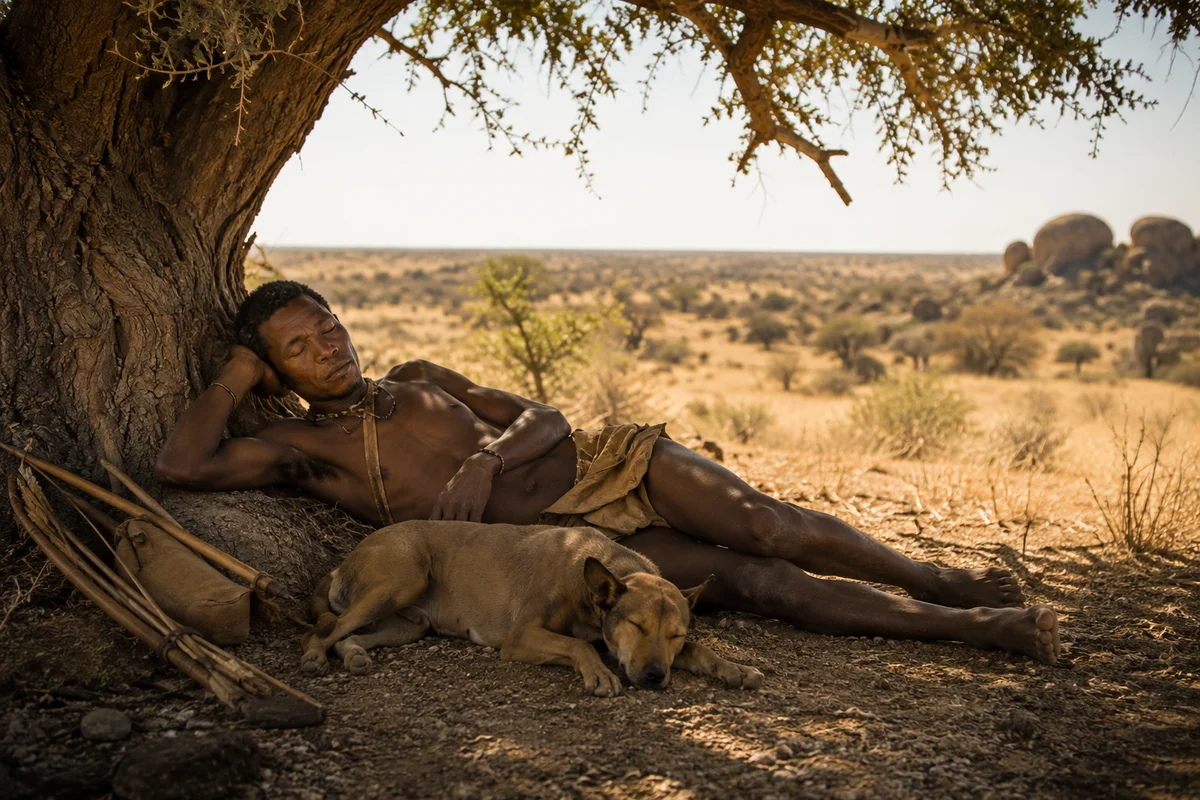
Consider the relationship between a human and a dog. A purely competitive lens might view the history of humanity and wolves as two species vying for territory and resources. Alternatively, this relationship functions as a biological collaboration known as coevolution.
Over thousands of years, humans and wolves changed their physical and behavioral configurations, becoming useful to one another within a shared environment. Humans developed the ability to read canine body language, while dogs evolved new facial muscles to communicate with humans. When a human and a dog make eye contact, both brains release oxytocin—the same hormone associated with maternal bonding. The human and the dog adjust their behaviors and biology to form a functional, harmonious survival unit.
Epigenetics and The Feral Pig
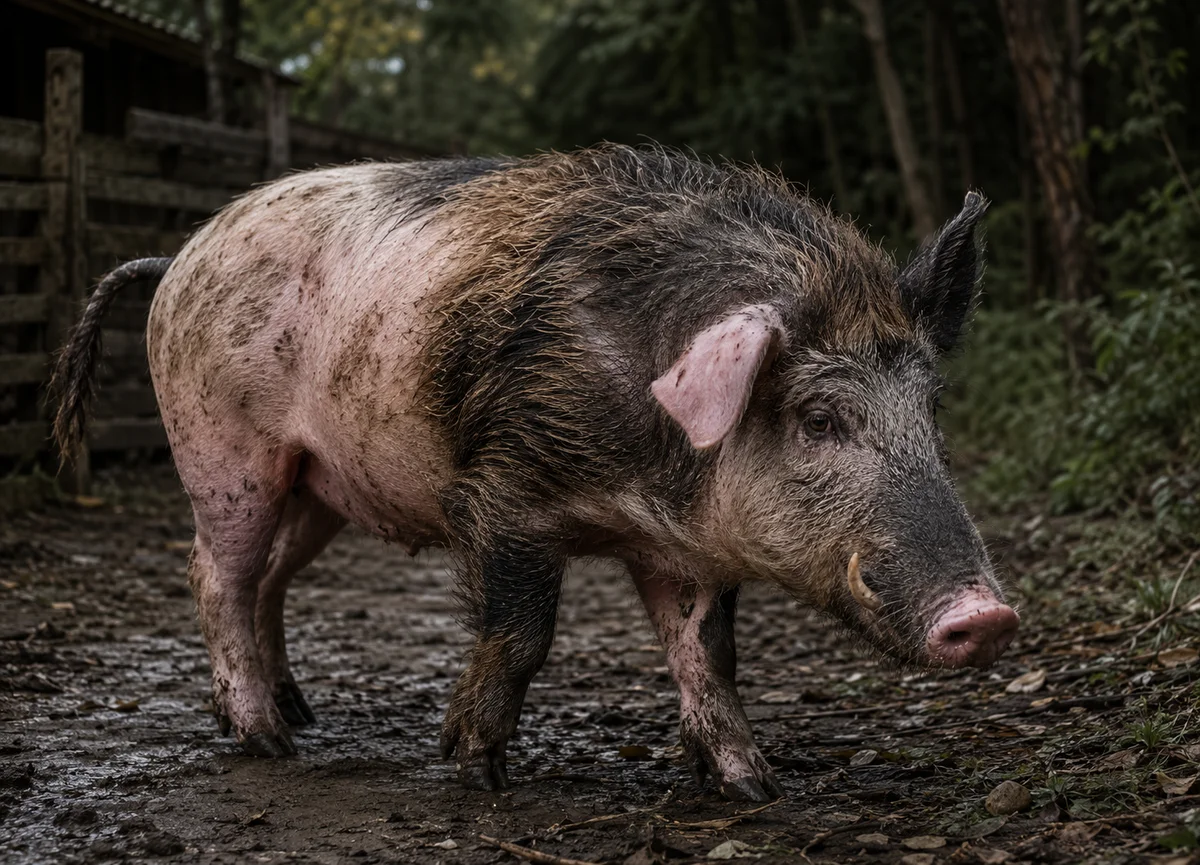
The domestic pig illustrates how rapidly an organism shifts its configuration to align with its environment. If a typical farm pig escapes into the wild, it undergoes a dramatic physical transformation within months. Triggered by new environmental demands, latent genetic traits activate through processes like epigenetics and phenotypic plasticity:
- It grows a thick coat of coarse hair to survive the elements.
- Its snout elongates for better rooting through forest soil.
- It grows tusks for foraging and defense.
- Its temperament shifts to become highly alert and aggressive.
The pig does not change as a form of competition; it changes to fit the specific conditions of the wild. In domesticity, the environment demands fat production and docility. In the forest, the environment demands different traits, and the pig alters its physical structure to negotiate a new path of least resistance. It molds itself to the shape of its surroundings.
Evolution by Merger: Endosymbiosis
In the 1960s, evolutionary biologist Lynn Margulis demonstrated that complex life forms emerged from cells merging rather than simply outcompeting one another.
This mechanism, known as endosymbiosis, indicates that the mitochondria in our cells were once independent bacteria. Billions of years ago, two single-celled organisms merged to survive changing environmental conditions. One provided shelter; the other provided energy. This structural cooperation forms the foundational basis for complex plant and animal life.
The Universe as a Dance and a Breath
Scaling this concept to a universal level aligns with Complex Systems Theory and thermodynamics. Systems naturally seek equilibrium and stability.
- The Breath: Ecosystems operate as closed, reciprocal loops. Plants process carbon dioxide and emit oxygen; animals process oxygen and emit carbon dioxide. The biological byproduct of one organism serves as the primary resource for another.
- The Dance: A river and the earth negotiate a path of least resistance, changing each other in the process. Organisms and their environments engage in a continuous cycle of adaptation.
The Function of Competition
This does not eliminate the existence of competition in nature. Competition is only as useful as a means for better cooperation, not as a race on its own.
When localized friction occurs—such as organisms vying for a strictly limited resource—it acts as a catalyst. This temporary tension forces life to find new niches, develop new symbiotic relationships, and discover more efficient ways to integrate into the broader ecosystem. The pressure resolves into a more complex equilibrium.
As evolutionary theorist Peter Kropotkin observed in his 1902 work Mutual Aid, in harsh environments, the species that cooperate are the ones that endure. Nature functions as an interconnected web, constantly shifting its structure and configuration, taking a collective breath, and adjusting toward harmony.
0 Comments